

From script to stage · Part 12: Beyond .NET

Cratis: from script to stage, and the long run · Part 12 of 26
Chronicle has clients for .NET, Kotlin and Java, TypeScript and Elixir, and all of them append to the same kernel through the same contract. Only one of them checks concurrency on an append unless you ask it to. The .NET client reads the tail of the event source and sends the sequence number it expects, so an append that lands between that read and its write fails. The Kotlin and Java client appends with no concurrency scope, and the TypeScript and Elixir clients send no check at all.
That’s one line in a table of differences, and it matters the day a second team picks a second language. The author feature is written in C#, and nothing in its uniqueness rule needs C#. A JVM or Node team can build the same feature on Cratis, once they know what exists for their language and where it departs from the .NET path.
One contract, several ecosystems
Section titled “One contract, several ecosystems”Not every team is on .NET, and not every service in one system should have to be. Arc’s HTTP contract is shared across three server implementations, and each generates TypeScript proxies for the frontend, though each has gaps of its own.
On the JVM, Arc for Kotlin is a Spring Boot implementation for Kotlin and Java, published to Maven Central. This command and its event come from its Chronicle Spring Boot sample, trimmed and with the id and title as concepts. The C# and TypeScript tabs have the same command, the TypeScript one from Arc for TypeScript’s Chronicle guide:
The same command in C#, where TaskId, an EventSourceId<Guid>, names the event source.
using Cratis.Arc.Authorization;using Cratis.Arc.Commands.ModelBound;using Cratis.Chronicle.Events;
[EventType]public record TaskCreated(TaskTitle Title);
[Command][AllowAnonymous]public record CreateTask(TaskId Id, TaskTitle Title){    public TaskCreated Handle() => new(Title);}
import io.cratis.arc.artifacts.Commandimport io.cratis.arc.artifacts.CommandKeyimport io.cratis.arc.authorization.AllowAnonymousimport io.cratis.chronicle.events.EventType
@EventTypedata class TaskCreated(val title: TaskTitle = TaskTitle(""))
@Command@AllowAnonymousdata class CreateTask(@CommandKey val id: TaskId, val title: TaskTitle) { fun handle(): TaskCreated = TaskCreated(title)}import io.cratis.arc.artifacts.Command;import io.cratis.arc.artifacts.CommandKey;import io.cratis.arc.authorization.AllowAnonymous;import io.cratis.chronicle.events.EventType;
@EventTypepublic record TaskCreated(TaskTitle title) {}
@Command@AllowAnonymouspublic record CreateTask(@CommandKey TaskId id, TaskTitle title) { public TaskCreated handle() { return new TaskCreated(title); }}import { field } from '@cratis/fundamentals';import { eventType } from '@cratis/chronicle/events';import { allowAnonymous, command, key } from '@cratis/arc.core';
@eventType()export class TaskCreated { @field(TaskTitle) title: TaskTitle; constructor(title: TaskTitle) { this.title = title; }}
@command()@allowAnonymous()export class CreateTask { @field(TaskId) @key() id!: TaskId; @field(TaskTitle) title!: TaskTitle;
handle(): TaskCreated { return new TaskCreated(this.title); }}Arc for Elixir doesn’t exist; use the Chronicle Elixir client directly.
The command returns the event, and Arc’s Chronicle integration, which the sample uses, appends it to the event source named by @CommandKey. Arc for Kotlin also has validation, authorization, tenancy, observable queries and in-process command scenarios. It isn’t at parity with .NET. Command operations and aggregates aren’t in it, and it runs only on Spring Boot.
The Node.js command is a decorated class, here from the source-only Tasks sample described in Arc for TypeScript, from source:
@command()export class RegisterTask {    @field(TaskId) id!: TaskId;    @field(TaskTitle) title!: TaskTitle;
    handle(tasks: Tasks): TaskId {        tasks.register(this.id, this.title);        return this.id;    }}
Chronicle has its own set of clients: a first-class .NET SDK, and clients for TypeScript, Kotlin/Java (JVM) and Elixir, over whichever storage provider each deployment chooses. Services in one system can use different clients against the same kernel. The clients aren’t interchangeable, though. The default concurrency check, ExpectingNoMatchingEvent, decision reads and some erasure options differ, and where the clients differ lists the gaps. Event sourcing in any language explains the shared contract underneath.
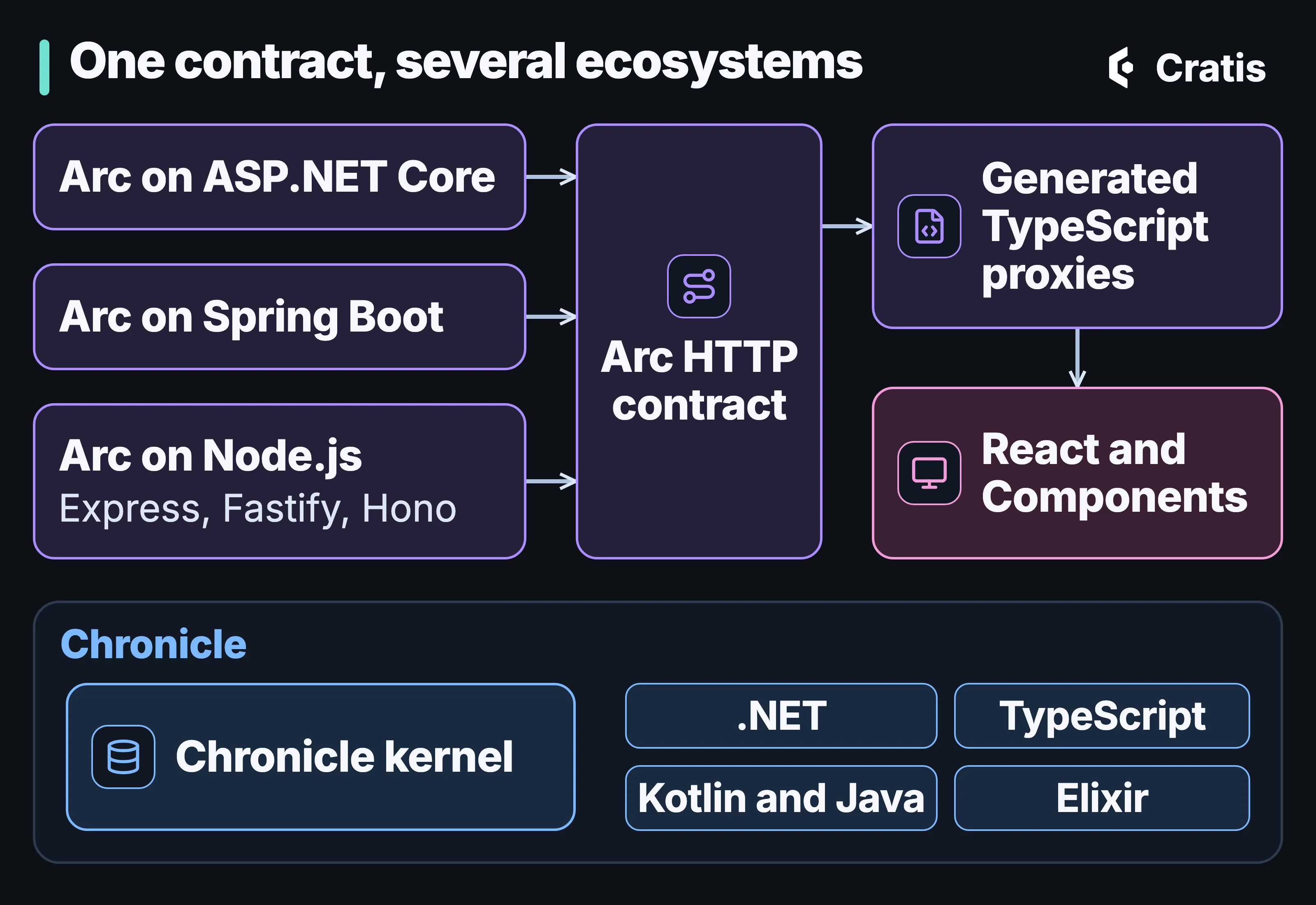
The contract is shared; each implementation states its own gaps.
Two things are shared and everything else belongs to a language. The Chronicle kernel runs the observers, the constraints and the storage, and a client registers its artifacts with it over gRPC and streams events to and from it. Arc’s contract fixes the command and query envelopes, the observable transports and the validation rules. For the frontend that means very little changes. The React code from Live UIs compiles against generated proxies, and @cratis/arc and @cratis/arc.react don’t care which server the proxies came from. What changes is how the backend declares its commands and queries, and how its events reach the log.
Arc on the JVM
Section titled “Arc on the JVM”Arc for Kotlin is MIT-licensed and published to Maven Central as io.cratis:arc. It runs on the Spring Boot servlet stack, where auto-configuration registers the HTTP, Server-Sent Events and optional WebSocket endpoints. Java gets the same treatment as Kotlin, with plain-Java samples and Java tabs in the docs for the same features. A handler can be an ordinary function, a Kotlin suspend function or a method returning a Java CompletionStage.
A command is a @Command class with a handle() method, and a query is a companion or static method on a @ReadModel type. KSP generates the handlers at compile time, so nothing is found by reflection when the application runs. Routes come from names, and CreateTask becomes POST /api/create-task. The package segments to leave out of a route are set twice, once in the Gradle plugin as cratisArc.endpoints.segmentsToSkip and once at runtime as cratis.arc.endpoints.segments-to-skip-for-route. If the two disagree, the starter refuses to start. Arc gotchas covers names doing the mapping on .NET. On the JVM, a mismatch is caught at startup.
A query stays live by returning something that emits. In Kotlin that’s a Flow or a StateFlow. In Java it’s a JDK Flow.Publisher or Arc’s ObservableState<T>, and with the optional arc-rxjava3 artifact it can be an RxJava 3 Observable. The Kotlin and Java tabs follow the observable queries guide, the TypeScript tab follows Arc for TypeScript’s guide to observable queries, and the C# tab is the same query for .NET. Like the guides, each keeps the tasks in one value for the whole process, not one per tenant:
The same query in C#, with a BehaviorSubject as the ISubject.
[ReadModel][AllowAnonymous]public record TaskView(TaskId Id, TaskTitle Title){    static readonly BehaviorSubject<IEnumerable<TaskView>> Tasks = new([]);
    public static ISubject<IEnumerable<TaskView>> All() => Tasks;}
private val _tasks = MutableStateFlow<List<TaskView>>(emptyList())
@ReadModel@AllowAnonymousdata class TaskView(val id: TaskId, val title: TaskTitle) { companion object { @JvmStatic fun all(): Flow<List<TaskView>> = _tasks }}@ReadModel@AllowAnonymouspublic record TaskView(TaskId id, TaskTitle title) { private static final ObservableState<List<TaskView>> tasks = new ObservableState<>(List.of());
public static Flow.Publisher<List<TaskView>> all() { return tasks; }}const tasks = new BehaviorSubject<TaskView[]>([]);
@readModel()@allowAnonymous()export class TaskView { @field(TaskId) id!: TaskId; @field(TaskTitle) title!: TaskTitle;
@query({ observable: true }) static all(): Observable<TaskView[]> { return tasks; }}Arc for Elixir doesn’t exist; use the Chronicle Elixir client directly.
MutableStateFlow does the job ISubject<T> does on .NET, and the state it holds matters. A source that only emits has nothing to answer a plain HTTP request with, so a snapshot GET against it returns 202 Not Ready unless the caller passes waitForFirstResult=true. The transports are the ones .NET uses, Server-Sent Events, WebSocket and an HTTP snapshot.
Validation is Jakarta Bean Validation, with reusable concept and model validators and shared fluent validators whose rules carry over into the generated client. The Gradle plugin, io.cratis.arc, generates strict-mode TypeScript for commands, queries, observables and models, validation metadata included, and the frontend uses it the way it would against .NET.
Events from a command
Section titled “Events from a command”Chronicle is optional on the JVM as well. io.cratis:arc has no Chronicle dependency, and an application can sit on JPA, MongoDB or plain services. For an event-sourced application the one dependency to take is io.cratis:cratis, which pulls in Arc, its Spring wiring and the Chronicle integration.
With it, a command returns an event and Arc appends it, as CreateTask does above. @EventType on the event is required. Arc’s Chronicle integration treats only @EventType values as events. A collection or routed wrapper that contains anything else fails before anything is appended, and a single unannotated value isn’t appended at all. Arc for Kotlin’s plain example returns a TaskCreated with no annotation, which is fine there because that sample has no event log, and wrong the moment Chronicle is involved. The Chronicle sample also gives every event property a default, as TaskCreated above does with val title: TaskTitle = TaskTitle(""), and the Chronicle client’s own examples declare events the same way.
@CommandKey is required too. It names the event source, and a command without one gets back a validation result with reasonDetail: "commandKey", because Arc won’t guess which event source you meant. Events returned inside one outermost command are staged and committed with a single appendMany call, which fails closed if the event store, the namespace or the correlation doesn’t match. That makes it a commit barrier for the event log. Chronicle, JPA and MongoDB can’t join one atomic transaction, and cross-store transactions aren’t planned.
Failures come back as validation results. A broken constraint has the reason constraintViolation, and a concurrency failure has concurrencyViolation with the expected and actual sequence numbers. When a decision depends on something the command read, EventsWithConcurrencyScopes sets an exact scope per event source. A Chronicle read model can be a handler parameter with no annotation, resolved by the command key and the tenant’s store, and read-model values go through Chronicle’s release step before a query hands them out.
A reactor can pass a registered command to Arc’s real pipeline through ChronicleCommandSideEffectHandler, and gets no roles unless it declares @ExecuteCommandsAsSystem. For specs, CommandScenario finds an in-memory event log through ServiceLoader, so a command spec runs with no kernel. Testing with Arc and Chronicle follows the same idea on .NET.
The Chronicle sample is strict about tenants. Every request has to carry the x-cratis-tenant-id header, and the sample resolves the event store in exactly that namespace, with no default tenant to fall back on. Where that header should come from in a real deployment is the subject of Tenancy and identity end to end.
What the JVM doesn’t have
Section titled “What the JVM doesn’t have”Arc for Kotlin runs on Spring Boot’s servlet stack only, so WebFlux and hosts outside Spring aren’t supported. Controller-based commands, static-file and SPA-fallback hosting, @FromRequest and @GenerateOneOf aren’t planned. Command operations and aggregate roots aren’t in the source, and Screenplay generation doesn’t target the JVM. Agreement with .NET is checked only in part: generated proxies against a captured .NET fixture, and HTTP behavior over nine common cases. MongoDB observables need a replica set, and Java’s delegated filters and validators need adapter beans.
Chronicle on the JVM
Section titled “Chronicle on the JVM”io.cratis:chronicle is the Kotlin and Java client, and its model is the one .NET developers know. @EventType goes on a data class or a record. A read model is a @ReadModel, and a @Reducer has one method per event. There’s no schema file and no registry to fill in. When the client connects, it finds the annotated artifacts on the classpath and registers them with the kernel in order.
In Kotlin every call to the kernel suspends. Java gets blocking bridges over the same surface and configures the client through ChronicleOptions. The Spring Boot starter, io.cratis:chronicle-spring-boot-starter, connects the client, registers the artifacts at startup, handles tenancy, identity and units of work per request, and gives you an injectable IEventStore. It targets Spring Boot 4 on the servlet stack, and its per-request features don’t apply to WebFlux.
By default the client constructs an artifact by calling a constructor with no parameters, or one where every parameter has a default. A reactor that needs a repository, or anything else from the container, needs an IArtifactActivator, and the starter supplies one.
A successful append means the fact is stored. The read model catches up asynchronously, so a read on the very next line can return null, and the client’s guide shows a bounded wait for the places that need one. Reactors take @OnceOnly and @Replay as they do on .NET. The client checks the kernel’s version when it connects and refuses a kernel it isn’t compatible with, and Arc for Kotlin’s Chronicle guide names a matching client and kernel pair. Running Chronicle in production covers the certificate-validation setup before connecting any client to a shared server.
Chronicle in TypeScript
Section titled “Chronicle in TypeScript”@cratis/chronicle is on npm. Its artifacts are decorators, such as @eventType for an event and @projection or @reducer for a read model. An append goes from a ChronicleClient to an EventStore to its EventLog. The appending example, without its service wrapper and with CustomerId and Money in place of a string and a number:
@eventType()class OrderPlaced {    @field(CustomerId) customerId: CustomerId;    @field(Money) total: Money;
    constructor(customerId: CustomerId, total: Money) {        this.customerId = customerId;        this.total = total;    }}
const result = await store.eventLog.append(    orderId,    new OrderPlaced(customerId, total));if (!result.isSuccess) { /* decide whether to retry or surface a conflict */ }
eventType comes from @cratis/chronicle and field from @cratis/fundamentals. The append sends no concurrency check, so when the event depends on something you read first, give the append an explicit scope.
The client needs Node.js 22.19 or later, because it’s built on undici, and it fails to import on Node 20. Standard decorators and top-level await need TypeScript 5.2 or later and an ES module build. A read model is inferred from a @projection, a @reducer or an exported model with @fromEvent, its schema comes from the model type, and its id defaults to the class name. skipTlsValidation defaults to true, as on every client, so set it to false for any shared server.
Chronicle in Elixir
Section titled “Chronicle in Elixir”cratis_chronicle is on Hex, and it’s written for OTP. An event is a struct that uses Chronicle.Events.EventType with an id. A read model uses Chronicle.ReadModels.ReadModel with a from Event, set: [...] mapping, a model-bound projection the kernel runs. Reactors, reducers and seeders follow the same pattern, there are model-bound unique and unique-event-type constraints, and identity, correlation and causation are metadata scoped to the process. The same append:
defmodule MyApp.Events.OrderPlaced do  use Chronicle.Events.EventType, id: "order-placed"
  defstruct customer_id: %MyApp.CustomerId{}, total: %MyApp.Money{}end
case Chronicle.append(order_id, %MyApp.Events.OrderPlaced{       customer_id: customer_id,       total: total     }) do  :ok -> :ok  {:error, _reason} = error -> errorend
Chronicle.append returns :ok or {:error, reason}, so there’s no sequence number to read back from a successful append. The client is a supervised child of your application, {Chronicle.Client, connection_string: ..., event_store: ..., otp_app: ...}. It connects and registers in the background with backoff, and until registration has finished, calls return {:error, :not_connected}. Lifecycle.wait_until(..., :registered) waits for it.
The client needs Elixir 1.18 or later and a kernel with contracts 19.19 or later. The Mint gRPC adapter needs enable_push: false, among other caveats. TLS has the same default as in TypeScript. Version 3.5.0 had defects, so take 3.5.1 or later.
Arc for TypeScript, from source
Section titled “Arc for TypeScript, from source”Arc for TypeScript is an early source preview of a TypeScript command and query server on Node.js. Its packages aren’t on npm, its version starts with 0, and its APIs can change. You run it from a clone, for example with yarn workspace @cratis/arc.core.sample.tasks start. Next to the RegisterTask command above, the Tasks sample has a live query:
@readModel()export class TaskItem {    @field(TaskId) id!: TaskId;    @field(TaskTitle) title!: TaskTitle;
    @query()    static observeAllTasks(tasks: Tasks): BehaviorSubject<TaskItem[]> { return tasks.observeAll(); }}
An observable query returns an RxJS BehaviorSubject, an Observable or an async iterable. The older defineCommand and defineQuery functions with Zod schemas still work.
Besides Express 5, Fastify 5 and Hono 4 there’s a standalone Node host, and a Fetch API entry, @cratis/arc.core/fetch, for Next.js route handlers, Bun and Deno. Next.js App Router route handlers run on the Node runtime. Cloudflare Workers and the Next.js Edge runtime aren’t supported, and there’s no NestJS adapter. Data comes from tenant-scoped MongoDB, which observes changes through a replica set, or from Drizzle over SQLite or PostgreSQL, with no change tracking and no SQL observation. There are no automatic migrations.
The Chronicle integration, @cratis/arc.chronicle, is experimental. It appends returned events and resolves read models by key. Returned events and command operations can’t be combined, and immediate appends, aggregates and reactor command effects don’t join the single event-log batch. Wire behavior is compared with Arc on .NET in a paired suite for a bounded set of HTTP cases, which doesn’t amount to parity. A source-based arc-proxygenerator writes a bounded client that compiles against the published @cratis/arc and @cratis/arc.react.
Where the clients differ
Section titled “Where the clients differ”These are the differences between the clients that change what your code has to do:
| .NET | Kotlin and Java | TypeScript | Elixir | |
|---|---|---|---|---|
| Concurrency on append, by default | Reads the tail, sends the expected sequence number | ConcurrencyScope.none |
No check | No check |
| Expect no matching event | ExpectingNoMatchingEvent |
withExpectsNoMatchingEvent() |
EventSequenceNumber.beforeFirst as the scope’s sequence number |
No |
| What an append returns | AppendResult |
AppendResult |
AppendResult |
:ok or an error tuple |
| Subject for personal data | Resolves [Subject] |
The event source id | The event source id | The event source id |
AllowNewEncryptionKeyFor |
Yes | No | Yes | No |
| Reactors and replay | [OnceOnly], [Replay] |
@OnceOnly, @Replay |
@onceOnly(), @replay() |
Replayable, no once-only marker |
| Delivery identity for reactors | ReactorDelivery.Id |
Build your own key | Build your own key | Build your own key |
An append that depends on an earlier read needs an explicit scope on every client. The .NET default only catches an append that lands between its own read of the tail and its write, and the first append into an empty scope isn’t checked unless you opt in. Outside .NET, an append without a scope isn’t checked at all. The subject row matters for personal data: outside .NET, pass the subject explicitly whenever it isn’t the event source. Personal data in an event log explains what the subject decides. A reactor that needs a stable key for its side effects has one on .NET, and elsewhere you build it from the event store, the namespace, the sequence, the reactor and the position, as Reacting to facts describes. Seeding behaves differently per client as well, in what it targets and how it handles duplicates.
![A diagram titled The same fact in four languages, four cards in a two-by-two grid: C#, Kotlin, TypeScript and Elixir. Each card shows the event-type declaration: [EventType] on a record AuthorRegistered in C#, @EventType on a data class TaskCreated in Kotlin, @eventType() on a class OrderPlaced in TypeScript, and use Chronicle.Events.EventType with the label defstruct with typed defaults in Elixir. Under each card a chip names the default concurrency on append: optimistic tail check for C#, none for Kotlin, TypeScript and Elixir. A band along the bottom reads: Concurrency on append, by default.](/_astro/same-fact-four-languages.COS5jcsu_ZAKPXS.webp)
One kernel contract, four client defaults.
Storage is the server’s choice
Section titled “Storage is the server’s choice”Chronicle Server’s storage provider is MongoDB by default. The others are PostgreSql, MsSql, Sqlite, which is embedded and file-based, and InMemory, which is ephemeral and non-durable. The provider is a server setting, and no client, in any language, sees which one it is.
The client chooses the read-model sink, not the server’s provider. Every client registers read models against the MongoDB sink unless you set the default sink type, and the sinks don’t behave the same. On the SQL sink each read model gets a table, with a JSON column for collections, and [Index] creates no index there. Only MongoDB creates them. A live Chronicle read model in the UI is documented on MongoDB, where Arc watches it through change streams. Arc’s EF Core observation sees writes from other processes only on PostgreSQL and SQL Server, with provider setup, and not on SQLite.
On .NET, Arc’s queries can read from MongoDB, or from a relational database through EF Core. Arc’s guide to adding event sourcing follows the MongoDB branch, where a Chronicle projection fills the collection an unchanged query already reads, and doesn’t cover projecting into the EF Core branch’s tables.
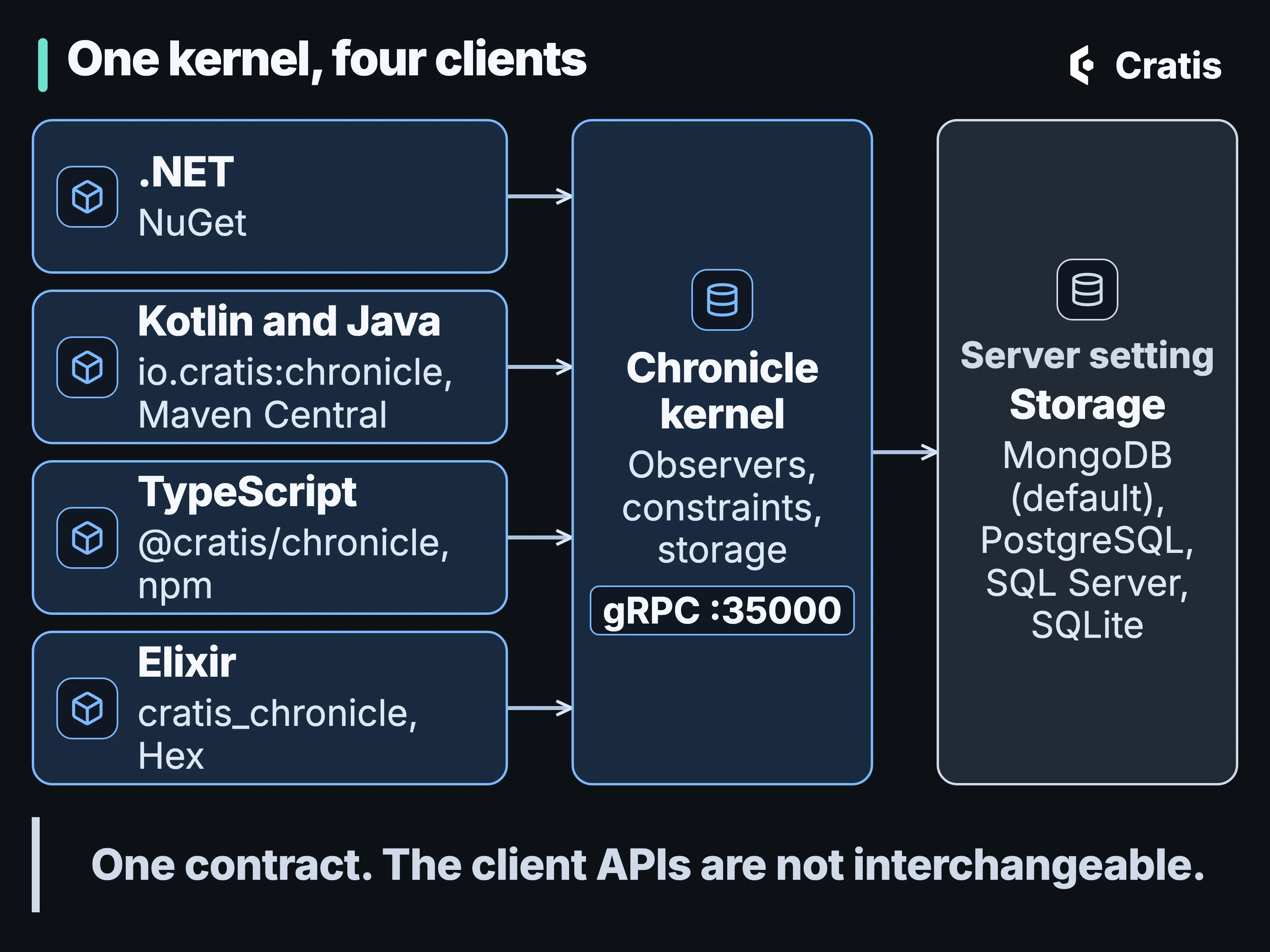
Four clients, one kernel, storage chosen by the server.
Starting on the JVM
Section titled “Starting on the JVM”The templates create JVM applications too, with dotnet new cratis --language Kotlin or --language Java. cratis new does the same without the .NET SDK. Either way the JVM path needs JDK 17.
In a clone of the Arc for Kotlin repository, ./Samples/run.sh starts the Kotlin sample with in-memory storage and the React frontend on port 5173. --language java switches to Java, --database mongodb to MongoDB, and --chronicle starts a development kernel pinned by digest. The Chronicle sample runs backend-only. There are four samples, Kotlin and Java, each with and without Chronicle, and they’re applications you run from source.
The author feature carries over. On Spring Boot, RegisterAuthor is a @Command that returns an @EventType event, keyed by a @CommandKey, and the generated TypeScript feeds the same React form. What doesn’t carry over is the defaults. Set a concurrency scope wherever a decision depends on something you read, and pass the subject when it isn’t the event source. Every client, .NET included, skips certificate validation by default, allowing the development image’s self-signed certificate. Turn it on (skipTlsValidation=false) before connecting to anything shared, following Running Chronicle in production.