

From script to stage · Part 06: Arc: commands and queries without the plumbing

Cratis: from script to stage, and the long run · Part 06 of 26
A C# record marked [Command] with a public Handle() method is enough for Arc to expose it as a POST endpoint, check its authorization, validate it and, with the proxy build package configured, write a TypeScript class the frontend compiles against. There’s no controller, no DTO and no list of registrations anywhere in the application. Arc finds the record, reads what’s declared on it and builds the rest.
Arc handles the author registration between the edge that knows who the user is and the event store that records what happened.
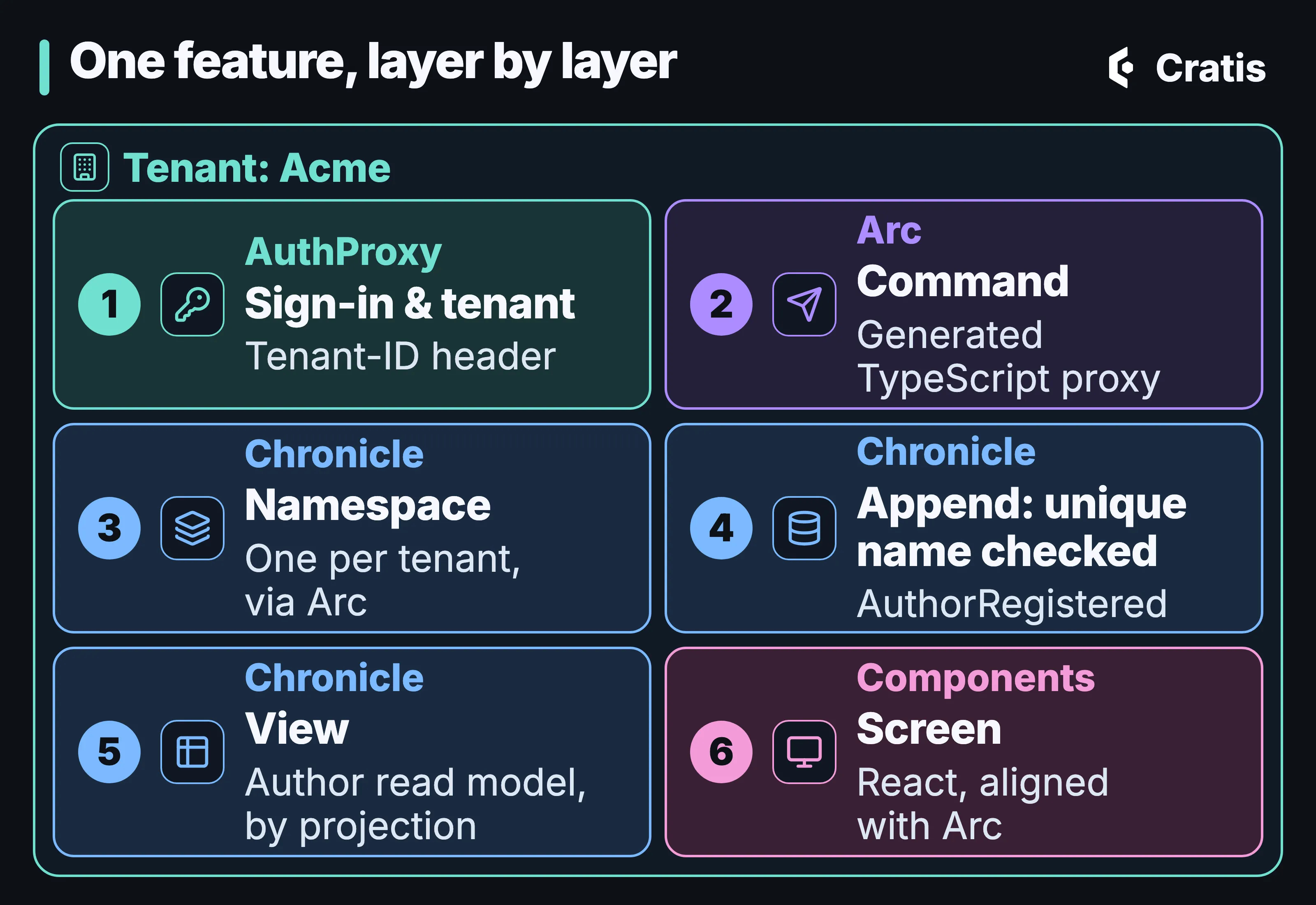
The author feature, step by step, and the product that owns each step.
The command
Section titled “The command”In Arc, RegisterAuthor is a command, which means a record with a Handle method. AuthorId and AuthorName are the feature’s own types:
[EventType]public record AuthorRegistered(AuthorName Name);
[Command]public record RegisterAuthor(AuthorId Id, AuthorName Name){ public AuthorRegistered Handle() => new(Name);}@EventTypedata class AuthorRegistered(val name: AuthorName)
@Commanddata class RegisterAuthor(@CommandKey val id: AuthorId, val name: AuthorName) { fun handle(): AuthorRegistered = AuthorRegistered(name)}@EventTypepublic record AuthorRegistered(AuthorName name) { }
@Commandpublic record RegisterAuthor(@CommandKey AuthorId id, AuthorName name) { public AuthorRegistered handle() { return new AuthorRegistered(name); }}@eventType()export class AuthorRegistered { @field(AuthorName) name: AuthorName; constructor(name: AuthorName = new AuthorName('')) { this.name = name; }}
@command()export class RegisterAuthor { @key() @field(AuthorId) id!: AuthorId; @field(AuthorName) name!: AuthorName;
handle(): AuthorRegistered { return new AuthorRegistered(this.name); }}Arc for Elixir doesn’t exist; use the Chronicle Elixir client directly.
The TypeScript tab is Arc for TypeScript, an early source preview whose packages aren’t on npm yet.
That’s the whole command. Arc gives it an HTTP route and runs validation and declared authorization on it ([Authorize], roles and policies). The handler returns an AuthorRegistered event, and the command can append the event it returns. You write no controller, no DTO and no registration list, and the name travels as a typed value instead of a bare string. The service code, the authorization policy and the storage stay yours.
In .NET, Arc discovers a command when the type has [Command] and a public instance Handle(). The route comes from the configured prefix, api by default, then the namespace in kebab-case with its leading segments skipped, then the type name. An explicit path is kept exactly as written. Nothing about this needs an event store.
AuthorId and AuthorName are concepts. The name is personal data, so its type is marked [PII] once, and a concept validator puts its rules on every author name:
public record AuthorId(Guid Value) : EventSourceId<Guid>(Value){    public static readonly AuthorId NotSet = new(Guid.Empty);    public static AuthorId New() => new(Guid.NewGuid());    public static implicit operator AuthorId(Guid value) => new(value);}
[PII]public record AuthorName(string Value) : ConceptAs<string>(Value){    public static readonly AuthorName NotSet = new(string.Empty);    public static implicit operator AuthorName(string value) => new(value);}
public class AuthorNameValidator : ConceptValidator<AuthorName>{    public AuthorNameValidator()    {        RuleFor(name => name.Value).NotEmpty().WithMessage("An author needs a name.");        RuleFor(name => name.Value).MaximumLength(200).WithMessage("An author name is at most 200 characters.");    }}
data class AuthorId(private val id: UUID) : ArcConceptAs<UUID>, ChronicleConceptAs<UUID> { override fun value(): UUID = id override val value: UUID get() = id
companion object { val NOT_SET = AuthorId(UUID(0, 0)) fun new(): AuthorId = AuthorId(UUID.randomUUID()) }}
@Piidata class AuthorName(private val name: String) : ArcConceptAs<String>, ChronicleConceptAs<String> { override fun value(): String = name override val value: String get() = name}
@Componentclass AuthorNameValidator : ConceptValidator<AuthorName> { override val conceptType: Class<AuthorName> = AuthorName::class.java
override fun validate(concept: AuthorName): List<ValidationResult> = when { concept.value().isBlank() -> listOf(ValidationResult.error("An author needs a name.")) concept.value().length > 200 -> listOf(ValidationResult.error("An author name is at most 200 characters.")) else -> emptyList() }}public record AuthorId(UUID value) implements ConceptAs<UUID>, io.cratis.chronicle.concepts.ConceptAs<UUID> { public static final AuthorId NOT_SET = new AuthorId(new UUID(0, 0));
public static AuthorId newId() { return new AuthorId(UUID.randomUUID()); }
@Override public UUID getValue() { return value; }}
@Piipublic record AuthorName(String value) implements ConceptAs<String>, io.cratis.chronicle.concepts.ConceptAs<String> { @Override public String getValue() { return value; }}
@Componentpublic final class AuthorNameValidator implements ConceptValidator<AuthorName> { @Override public Class<AuthorName> getConceptType() { return AuthorName.class; }
@Override public List<ValidationResult> validate(AuthorName concept) { if (concept.value().isBlank()) { return List.of(ValidationResult.error("An author needs a name.")); } if (concept.value().length() > 200) { return List.of(ValidationResult.error("An author name is at most 200 characters.")); }
return List.of(); }}From Arc for TypeScript, an early source preview whose packages aren’t on npm yet:
export class AuthorId extends ConceptAs<Guid> {    static readonly valueType = Guid;
    static create(): AuthorId {        return new AuthorId(Guid.create());    }}
@pii()export class AuthorName extends ConceptAs<string> {    static readonly valueType = String;}
@validator(AuthorName)export class AuthorNameValidator extends ConceptValidator<AuthorName> {    constructor() {        super();        this.ruleFor(name => name.value).notEmpty().withMessage('An author needs a name.');        this.ruleFor(name => name.value).maxLength(200).withMessage('An author name is at most 200 characters.');    }}
Arc for Elixir doesn’t exist, so there’s no validator. The Chronicle Elixir client declares the two concepts:
defmodule MyApp.AuthorId do  use Chronicle.Concept, type: :uuid, event_source_id: trueend
defmodule MyApp.AuthorName do  use Chronicle.Concept, type: :string  pii()end
On the wire AuthorName is just the string, and every Arc proxy generator types it as the underlying primitive in the generated TypeScript, so the C# model gets a named type without the HTTP contract getting a wrapper object.
Dependencies go on Handle() as parameters, resolved from the command’s service scope. A CancellationToken parameter gets the request-aborted token over HTTP. A command that produces the new author’s id itself, here RegisterNewAuthor, shows the other half of the model:
[Command]public record RegisterNewAuthor(AuthorName Name){ public (AuthorId, AuthorRegistered) Handle() => (AuthorId.New(), new AuthorRegistered(Name));}@Commanddata class RegisterNewAuthor(val name: AuthorName) { fun handle(): Pair<AuthorId, EventForEventSourceId> { val authorId = AuthorId.new() return authorId to EventForEventSourceId(authorId.value().toString(), AuthorRegistered(name)) }}@Commandpublic record RegisterNewAuthor(AuthorName name) { public CommandResponseValues handle() { var authorId = AuthorId.newId(); return CommandResponseValues.of( authorId, new EventForEventSourceId(authorId.value().toString(), new AuthorRegistered(name))); }}@command()export class RegisterNewAuthor { @field(AuthorName) name!: AuthorName;
handle() { const authorId = AuthorId.create(); return tuple(eventSourceIdResponse(authorId.toString()), new AuthorRegistered(this.name)); }}Arc for Elixir doesn’t exist; use the Chronicle Elixir client directly.
When a command needs data loaded first, such as a read model or an answer from another service, Provide() loads it. It runs after the request has passed authorization and validation, whatever it returns is handed to Handle(), and it can also stop the command with a validation result.
In .NET, what Handle() returns decides the response. void and Task give no response. A plain T or Task<T> becomes the response, unless a response handler claims it. A Result<TSuccess, TError> from Cratis.Monads is processed for whichever alternative is active. A tuple is split. Arc processes the values it has handlers for and allows at most one unhandled value, which becomes the response. In the command above, the Chronicle integration appends the event under the new AuthorId, and the id goes back to the caller as the response. Two unhandled values fail with MultipleUnhandledTupleValues. An arbitrary error record doesn’t mark a command as failed on its own, and a returned ValidationResult does.
The order is part of the contract
Section titled “The order is part of the contract”Arc runs every command through the same pipeline, and the order matters as much as the steps.
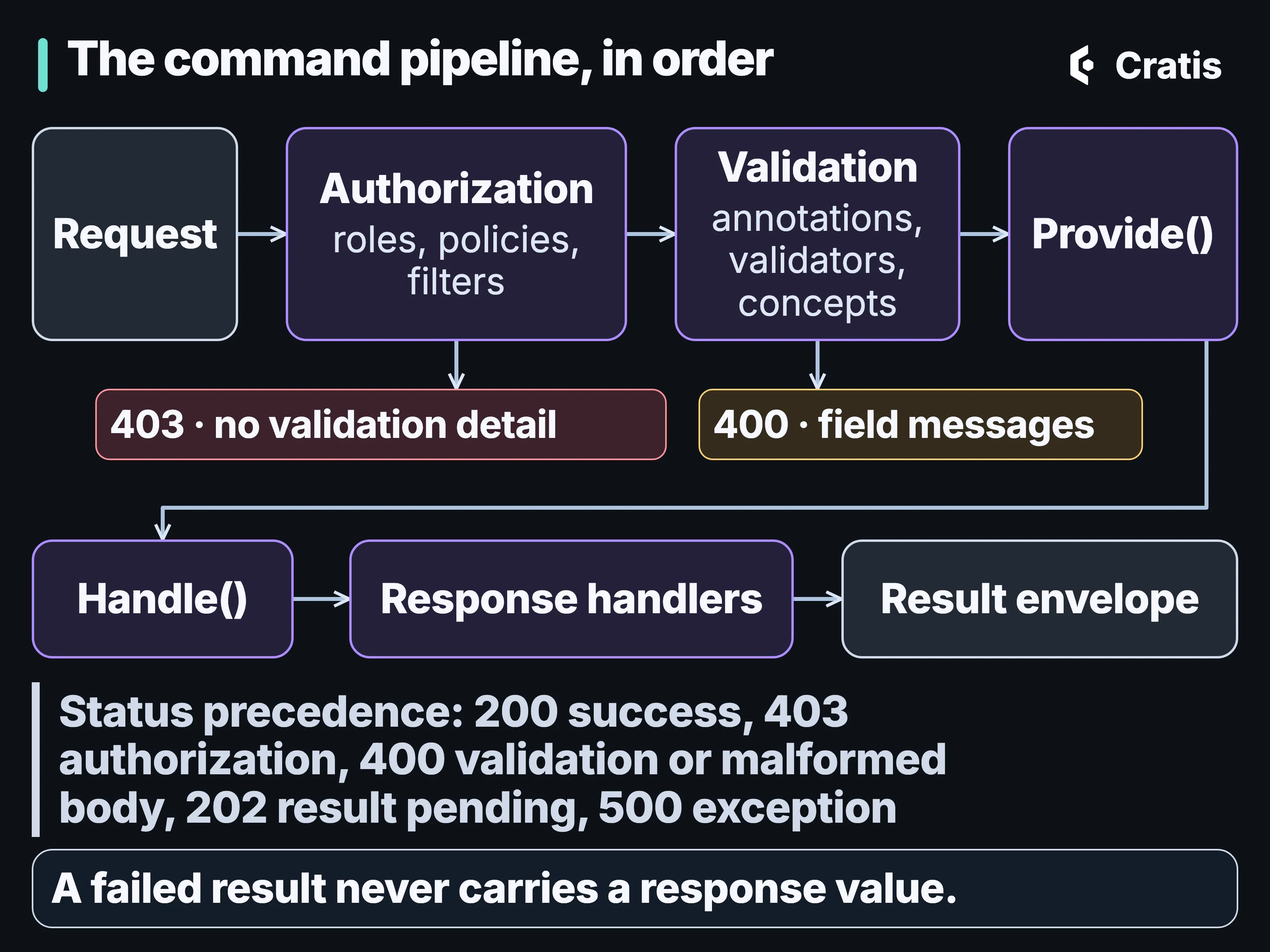
Authorization is decided before anything looks at the command’s values.
Authorization comes first. The built-in authorization filter is ordered ahead of the ordinary command filters, so a caller who isn’t allowed never reaches validation, Provide() or Handle(). The response is a 403, and it carries no validation detail. A forbidden caller who can see which fields failed has learned something about a command they weren’t allowed to run, which is why the 403 carries nothing else.
Arc pins that behavior with a spec. It registers the validation filter first on purpose, and then checks that authorization still wins:
// The validation filter is registered first on purpose: authorization must still be decided first (by Order),// so a forbidden caller whose command is also invalid gets a clean 403 and the validation filter never runs.var filters = new List<ICommandFilter> { _validationFilter, authorizationFilter };// ...[Fact] void should_not_be_authorized() => _result.IsAuthorized.ShouldBeFalse();[Fact] void should_not_be_successful() => _result.IsSuccess.ShouldBeFalse();[Fact] void should_map_to_forbidden_not_bad_request() => EndpointRouteHelper.GetStatusCode(_result.IsSuccess, _result.IsAuthorized, _result.IsValid).ShouldEqual(HttpStatusCode.Forbidden);[Fact] void should_not_run_the_validation_filter() => _validationFilter.WasCalled.ShouldBeFalse();[Fact] void should_not_leak_any_validation_detail() => _result.ValidationResults.ShouldBeEmpty();Validation runs next; Validation all the way down covers command and concept validators, data annotations and the severity header. On a positional record, DataAnnotations must target the property, as in [property: Required], because the filter doesn’t read attributes on constructor parameters.
Then Provide(), then Handle(), then response handlers, command operations and the execution scope.
The HTTP contract fixes the status codes in the same order. Success is 200. An authorization failure is 403 (401 when authentication itself fails). A validation failure, a malformed body or a dependency Arc can’t resolve is 400. A result that isn’t ready yet is 202, and an exception is 500. A failed result never carries a response value. A malformed or wrongly typed body turns into a validation failure with the reason malformedRequest, and the parser’s own message isn’t echoed back. Outside the Development environment, exception messages and stack traces are replaced with a generic message, and the detail is logged on the server with the correlation id.
For early form feedback, use the command’s POST <route>/validate endpoint. A check that passes reserves nothing, so the real POST can still fail; Validation all the way down covers what the endpoint runs and what it leaves out.
Exceptions thrown by a handler, a filter, a response handler or the execution scope are caught into the CommandResult. If a handler wrote to a service directly and a later step failed, Arc catches the exception but doesn’t roll that write back.
Authorization sits on the artifact
Section titled “Authorization sits on the artifact”Authorization is declared on the command or query it protects. [Authorize] requires an authenticated caller. [Roles("A", "B")] requires any one of the listed roles. [Authorize(Policy = ...)] names a policy, either a scoped IAuthorizationPolicy or an ASP.NET policy on an ASP.NET host, and [AllowAnonymous] opens the artifact up. With no requirement at all, the built-in check permits access. Putting [AllowAnonymous] together with [Authorize] or [Roles] on one target is ambiguous. The ARC0019 analyzer reports it at build time, and at run time Arc rejects the call. A rule that applies across many commands goes in an IAuthorizationCommandFilter that returns CommandResult.Unauthorized.
Queries are authorized the same way, and a method-level attribute replaces the type-level one:
using Cratis.Arc.Authorization;using Cratis.Arc.Queries.ModelBound;using MongoDB.Driver;
namespace Banking.Accounts;
public enum AccountRole { AccountReader, Admin, Auditor }
[ReadModel][Roles(nameof(AccountRole.AccountReader))]public record DebitAccount(AccountId Id, AccountName Name, Amount Balance){    [Path("/api/accounts")]    public static IQueryable<DebitAccount> AllAccounts(IMongoCollection<DebitAccount> collection) =>        collection.AsQueryable();
    [Roles(nameof(AccountRole.Admin), nameof(AccountRole.Auditor))]    [Path("/api/accounts/overdrawn")]    public static IQueryable<DebitAccount> OverdrawnAccounts(IMongoCollection<DebitAccount> collection) =>        collection.AsQueryable().Where(account => account.Balance < new Amount(0));}
package banking.accounts
import io.cratis.arc.artifacts.FromServicesimport io.cratis.arc.artifacts.ReadModelimport io.cratis.arc.authorization.Rolesimport io.cratis.arc.queries.Path
@ReadModel@Roles("AccountReader")data class DebitAccount(val id: AccountId, val name: AccountName, val balance: Amount) { companion object { @JvmStatic @Path("/api/accounts") fun allAccounts(@FromServices accounts: DebitAccountRepository): List<DebitAccount> = accounts.findAll()
@JvmStatic @Roles("Admin", "Auditor") @Path("/api/accounts/overdrawn") fun overdrawnAccounts(@FromServices accounts: DebitAccountRepository): List<DebitAccount> = accounts.findOverdrawn() }}package banking.accounts;
import io.cratis.arc.artifacts.FromServices;import io.cratis.arc.artifacts.ReadModel;import io.cratis.arc.authorization.Roles;import io.cratis.arc.queries.Path;import java.util.List;
@ReadModel@Roles("AccountReader")public record DebitAccount(AccountId id, AccountName name, Amount balance) { @Path("/api/accounts") public static List<DebitAccount> allAccounts(@FromServices DebitAccountRepository accounts) { return accounts.findAll(); }
@Roles({"Admin", "Auditor"}) @Path("/api/accounts/overdrawn") public static List<DebitAccount> overdrawnAccounts(@FromServices DebitAccountRepository accounts) { return accounts.findOverdrawn(); }}import { field } from '@cratis/fundamentals';import { path, query, readModel, roles, service } from '@cratis/arc.core';import { mongoCollection, type MongoCollection } from '@cratis/arc.mongodb';import { AccountId } from './AccountId.js';import { AccountName } from './AccountName.js';import { Amount } from './Amount.js';
export class DebitAccount { @field(AccountId) id!: AccountId; @field(AccountName) name!: AccountName; @field(Amount) balance!: Amount;}
const accounts = mongoCollection(DebitAccount);
@readModel()@roles('AccountReader')export class DebitAccounts { @query(service(accounts)) @path('/api/accounts') static allAccounts(items: MongoCollection<DebitAccount>): Promise<DebitAccount[]> { return items.find(); }
@roles('Admin', 'Auditor') @query(service(accounts)) @path('/api/accounts/overdrawn') static overdrawnAccounts(items: MongoCollection<DebitAccount>): Promise<DebitAccount[]> { return items.find({ balance: { $lt: 0 } }); }}Arc for Elixir doesn’t exist; use the Chronicle Elixir client directly.
A role says what kind of caller someone is. It doesn’t say which records are theirs. An account reader in that example can read every account. If each caller should only see their own, the query has to derive the owner from the authenticated principal and filter on it, and Arc has no universal mapping from a claim to an owner that could do it for you.
Arc doesn’t authenticate anyone either. The host establishes the principal, through ASP.NET authentication or an edge proxy such as AuthProxy, and Arc’s attributes check it. Arc doesn’t validate or modify the identity provider’s token. An identity details provider can compose application-specific details from the principal, and Arc registers /.cratis/me for the frontend only when such a provider exists. The .cratis-identity cookie that carries those details is unsigned and under the client’s control. It’s display data, and backend authorization must never rest on it.
Two more endpoints are open by default. /.cratis/commands and /.cratis/queries list every command and query with its route and schema, and on .NET they’re anonymous unless you configure them otherwise.
A resolver, whether it reads a header, a query string, a claim or a subdomain, selects a tenant. It doesn’t check that the caller belongs to it, and a header the caller controls isn’t evidence of membership. Tenancy and identity end to end follows the tenant from the edge to the event store.
A query is a static method on the read model
Section titled “A query is a static method on the read model”A model-bound query is a static method on the record it returns. Mark the record [ReadModel], and any non-generic public or internal static method that returns that type, a collection of it or a supported wrapper becomes a GET endpoint. The supported wrappers include Task<T>, ISubject<T> for a query that keeps pushing results, and IQueryable<T> for paging and sorting. A QUERY method that takes its arguments as a JSON body is registered alongside by default, with Cache-Control: no-store. A method that returns some other type isn’t discovered.
Parameters work the way they do on a command. Arc resolves a parameter from the container when it can, as with the IMongoCollection<DebitAccount> above, and treats the rest as arguments from the caller. [Path] fixes the route.
The response is an envelope with data, isReady, isAuthorized and validationResults, plus paging with a zero-based page, the page size, total items and total pages. A query that returns null has succeeded. Arc doesn’t turn it into a 404.
The read model doesn’t have to come from Chronicle. It can come from MongoDB, EF Core, another service or memory. Arc without event sourcing is a supported way to use it, and Chronicle never depends on Arc.
Returning ISubject<T> instead of a list makes it an observable query, and a browser that subscribes gets later results pushed to it. Live UIs is about that path.
The TypeScript the build writes
Section titled “The TypeScript the build writes”At build time, Arc’s proxy generator loads the compiled assembly and writes a TypeScript file for each command and query into the folder you configure. A command becomes a class that extends Command<ICommandName> and carries its route. Its interface has the C# XML documentation as comments. The class has typed property accessors, property descriptors and a validator, plus the roles from the C# attributes. A static use() hook for React returns the command with functions to set and clear its values.
In .NET, validation rules are extracted from the compiled model and projected into the generated validator. The Ideas board sample in the Cratis Samples repository has a title concept with a rule on it:
public record IdeaTitle(string Value) : ConceptAs<string>(Value){    public static readonly IdeaTitle NotSet = new(string.Empty);    public static implicit operator IdeaTitle(string value) => new(value);}
public class IdeaTitleValidator : ConceptValidator<IdeaTitle>{    public IdeaTitleValidator() => RuleFor(_ => _.Value).NotEmpty().MaximumLength(72);}
Arc for Kotlin and Java runs ConceptValidator rules on the server only; the generated TypeScript gets its client rules from Jakarta constraint annotations and shared FluentModelValidator rules.
data class IdeaTitle(private val title: String) :    io.cratis.arc.concepts.ConceptAs<String>,    io.cratis.chronicle.concepts.ConceptAs<String> {    override fun value(): String = title    override val value: String get() = title
    companion object {        val NOT_SET = IdeaTitle("")    }}
@Componentclass IdeaTitleValidator : ConceptValidator<IdeaTitle> {    override val conceptType: Class<IdeaTitle> = IdeaTitle::class.java
    override fun validate(concept: IdeaTitle): List<ValidationResult> = buildList {        if (concept.value().isBlank()) add(ValidationResult.error("A title is required."))        if (concept.value().length > 72) add(ValidationResult.error("A title can be at most 72 characters."))    }}
Arc for Kotlin and Java runs ConceptValidator rules on the server only; the generated TypeScript gets its client rules from Jakarta constraint annotations and shared FluentModelValidator rules.
public record IdeaTitle(String value)        implements io.cratis.arc.concepts.ConceptAs<String>, io.cratis.chronicle.concepts.ConceptAs<String> {    public static final IdeaTitle NOT_SET = new IdeaTitle("");
    @Override    public String getValue() {        return value;    }}
@Componentpublic final class IdeaTitleValidator implements ConceptValidator<IdeaTitle> {    @Override    public Class<IdeaTitle> getConceptType() {        return IdeaTitle.class;    }
    @Override    public List<ValidationResult> validate(IdeaTitle concept) {        var results = new ArrayList<ValidationResult>();        if (concept.value().isBlank()) results.add(ValidationResult.error("A title is required."));        if (concept.value().length() > 72) results.add(ValidationResult.error("A title can be at most 72 characters."));        return results;    }}
export class IdeaTitle extends ConceptAs<string> { static readonly valueType = String; static readonly NotSet = new IdeaTitle('');}
@validator(IdeaTitle)export class IdeaTitleValidator extends ConceptValidator<IdeaTitle> { constructor() { super(); this.ruleFor(_ => _.value).notEmpty().maxLength(72); }}Arc for Elixir doesn’t exist; use the Chronicle Elixir client directly.
The command that captures an idea carries an IdeaTitle and an IdeaSummary, whose own concept validator limits it to 240 characters. In .NET, after a build, the generated CaptureIdea.ts has both rules, and the hook:
export class CaptureIdeaValidator extends CommandValidator<ICaptureIdea> { constructor() { super(); this.ruleFor(c => c.summary).notEmpty(); this.ruleFor(c => c.summary).maxLength(240); this.ruleFor(c => c.title).notEmpty(); this.ruleFor(c => c.title).maxLength(72); }}// ...static use(initialValues?: ICaptureIdea): [CaptureIdea, SetCommandValues<ICaptureIdea>, ClearCommandValues] { return useCommand<CaptureIdea, ICaptureIdea>(CaptureIdea, initialValues);}In .NET, nobody wrote maxLength(72) in TypeScript. It came from the concept. When several sources contribute rules for one member, an explicit FluentValidation validator takes precedence, direct concept-validator rules add to it, and DataAnnotations fill in only where nothing else contributed.
The browser gets only the rules the generator can translate; Validation all the way down covers that subset and why passing it doesn’t guarantee a successful POST.
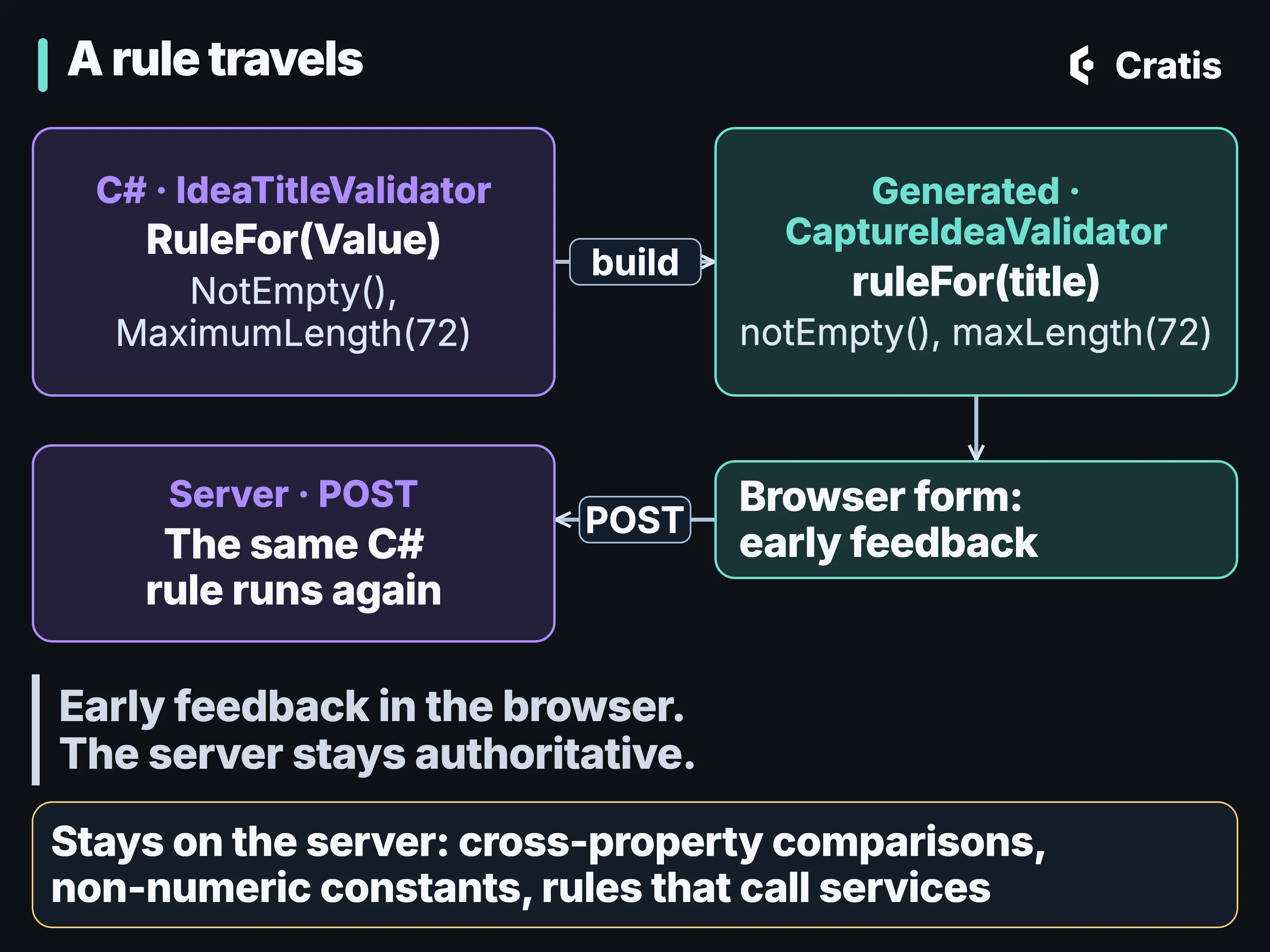
Written once on a concept, checked early in the browser and again on the server.
Rename Title on the C# command, rebuild, and every piece of TypeScript that used the old accessor stops compiling. Drift between the backend and the frontend shows up as a compile error in your own build, before anyone opens a browser. That only holds if the build runs in order, backend first so the proxies are regenerated, then the frontend.
Setting it up takes the build package, a CratisProxiesOutputPath pointing at a folder that holds only generated files, and the @cratis/arc, @cratis/arc.react and @cratis/fundamentals packages on the frontend. The MSBuild integration writes incrementally, keeping files whose content hash still matches and removing stale ones. A full regeneration, through the generator executable or with CratisProxiesSkipOutputDeletion=false, deletes the entire output directory, handwritten files included, which is why the folder should hold nothing else. The generated files start with a DO NOT EDIT header, and a later build can overwrite anything changed in them. Arc gotchas collects the ways this bites.
Only public properties declared directly on the command type become fields in the proxy. Properties inherited from a base type aren’t collected.
The same pipeline without HTTP
Section titled “The same pipeline without HTTP”A background worker can run a command through the same pipeline. Inject ICommandPipeline and call Execute<TResult>(command), and you get a result with IsSuccess, IsAuthorized, IsValid, HasExceptions, ValidationResults and a CorrelationId. Validate(command) runs the filters and stops before Provide() and Handle().
The typed Execute<T> returns default(TResult) when the command fails, so a failed command that should have produced a Guid hands back Guid.Empty. Check IsSuccess. IsValid alone misses authorization failures and exceptions.
Work outside a request has no header to read and no signed-in user. ITenantScope.Begin(tenant) selects a tenant for the work, and ISystemExecution.AsSystem(roles) runs it as a trusted system identity with the roles you name. Testing with Arc and Chronicle runs the pipeline in a spec, in one process.
The Chronicle bridge, if you want it
Section titled “The Chronicle bridge, if you want it”Chronicle is optional. With the Chronicle integration package, the events a command returns from Handle() are appended for it, whether that’s a single event, a collection, a tuple or a Result. They join the command’s pending transaction, so the batch commits when the command succeeds and rolls back when it fails, unless your code completed that transaction earlier. That’s the one kind of write Arc does undo. A direct write to another service still isn’t.
The event source id comes from a convention. A command that implements ICanProvideEventSourceId supplies it. Otherwise Arc takes the first property that’s an EventSourceId, a descendant of EventSourceId<T> or marked [Key], and if there’s none, it creates a new EventSourceId.
The command also leaves a trace. In .NET and TypeScript, its name and property values are recorded in the causation of every event it appends, and [PII] and [NotAudited] keep top-level values out of that record. The subject, the identity personal data is keyed to, can be returned from Handle() as well. Personal data in an event log explains why both matter.
A Chronicle read model can be a parameter of a command’s validator, Provide() or Handle(), looked up by the key the command already carries. It has to be backed by a projection or a reducer. If the instance doesn’t exist, a nullable parameter gets null, and a non-nullable one fails the command with ReadModelDoesNotExistForCommand before your code runs. [ReadModel] on its own doesn’t make a type injectable. Rules that hold when you write covers decision reads and aggregates, which build on this.
What Arc does and what stays yours
Section titled “What Arc does and what stays yours”For the author feature, Arc turned one record into a route, an authorization check, a validation step and a TypeScript class, and with the Chronicle integration it appended the event the handler returned. The query that lists authors is a static method on the Author read model, and it’s routed and authorized the same way.
Arc evaluates what’s declared on the artifact, against a principal someone else established. The host or the edge proxy authenticates. Which records belong to which caller, and whether a caller belongs to the tenant they selected, are rules the application writes. Storage per tenant is configuration you choose, and with EF Core a tenant-specific connection is yours to set up.
Arc for Kotlin and Java on Spring Boot and Arc for TypeScript share the HTTP contract and generate the same kind of proxies, each with its own gaps compared with .NET, and Beyond .NET goes through them.