

Turning read protection on in an application that already runs · Decisions that hold, Part 6

Decisions that hold · Part 06 of 11
Part 2 turned a validator’s read into a guard with one project setting, <CratisReadProtection>On</CratisReadProtection>. New applications from the Cratis templates have that setting already. An application that already runs is a different matter. It has commands that read through IReadModels, read models with joins, and services that append to the event log as a side effect, and under On each of those fails the command instead of running unguarded. Part 5 went through those refusals one by one. This part is about finding them before your users do.
Why On is not a flag you flip
Section titled “Why On is not a flag you flip”Read protection is Off by default today. Making On the default is planned for a future major version of Arc (Cratis/Arc#3255), so an explicit <CratisReadProtection> setting also keeps the mode from changing under you when you upgrade. There are three reasons not to jump straight to On in existing code:
- A protected command fails closed. It refuses a read it can’t guard, an immediate append and a read outside a parameter. Commands that work today would start returning
500s. - Moving a read from
Handle()into a parameter or a validator changes where a rule lives and what it decides from. That’s a code change per command, not a setting. - A guarded read is a fresh fold of the key’s history, and costs more than a plain one. A team should choose that where a rule needs it.
So Arc has a third mode between the two.
The path
Section titled “The path”| Step | Mode | What you do | What callers see |
|---|---|---|---|
| 1 | Off |
Update the packages | Nothing changes |
| 2 | Measure |
Set the mode, run the application and its tests | Nothing changes. Arc records what On would do |
| 3 | Measure |
Read the report. Fix each refused read and immediate append, or mark a read advisory | The fixes are ordinary code changes |
| 4 | On, one project at a time |
Switch the project and run its tests | Reads are guarded, reads Arc can’t guard fail the command, and validation errors block whatever severity the caller allows |
Measure is set the same way as On, in the project that contains the commands or in a Directory.Build.props that covers several:
<PropertyGroup> <CratisReadProtection>Measure</CratisReadProtection></PropertyGroup>Modes mix. A command can stay where it is while its project moves: [ReadProtection(ReadProtectionMode.Off)] (namespace Cratis.Arc.Commands) keeps one command Off in a Measure or On project, and [ReadProtection(ReadProtectionMode.On)] turns one command on ahead of the rest. A command-level [Unprotected] means Off for that command.
Read protection is part of Arc for .NET.
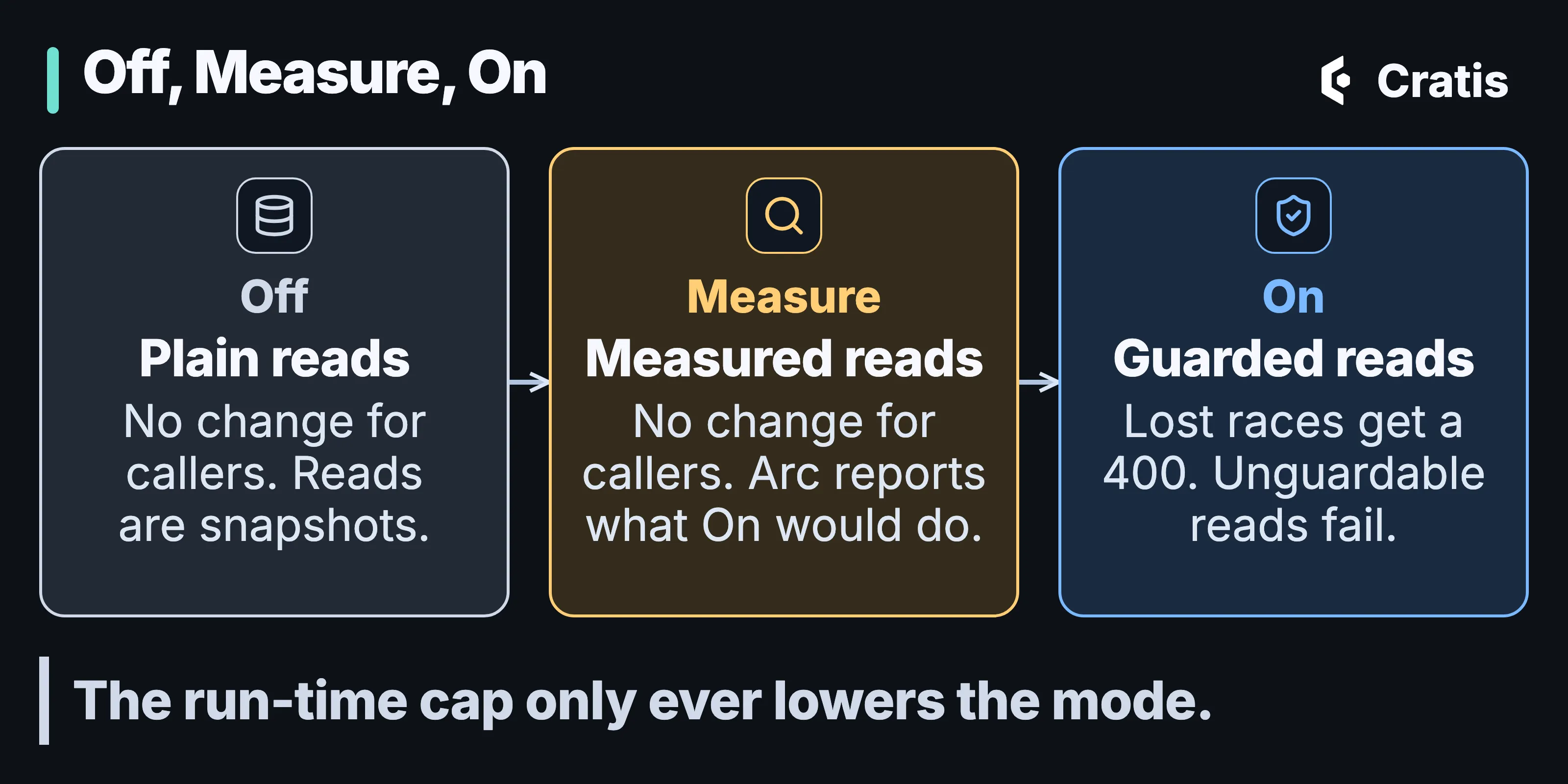
Callers see a difference only under On.
What Measure does and what it costs
Section titled “What Measure does and what it costs”Under Measure, reads, key lookups, concurrency scopes, results and status codes stay as they are under Off. A read model in a validator is still a plain read, and it still guards nothing. What Arc adds is a record of what On would have done with each command. A failure inside that measurement never fails the command.
It does three things:
- On the request path, it classifies each parameter Arc resolves for the command: a read model
Onwould guard, a readOnwould refuse, an advisory read, or a dependency Arc can’t see into. This is local reflection and costs nothing beyond that. - At the start of each command, it reads the event log’s tail once. This is the one awaited call Measure adds, and it has a timeout of 250 ms by default.
- After the command, on a sample of commands (10 percent by default), a background scan looks for events written by someone else between that tail and the scan that match what the command read. These are the commands where
Onmight have returned a400.
The sample rate, the tail timeout, the scan timeout and the most events one scan looks at are runtime settings (MeasureSampleRate, MeasureTailTimeout, MeasureScanTimeout, MeasureScanLimit) in the ReadProtection configuration section. No benchmark of Measure is published. The cost has the shape above: one extra awaited call per command and background reads on a sample.
It’s best effort. A command whose tail read timed out, or whose scan was dropped, is reported as measurement_unavailable and counts as no evidence either way. The report is a set of hypotheses about On. It isn’t protection, and an application in Measure is exactly as unguarded as one in Off.
What the report looks like
Section titled “What the report looks like”Take an illustrative library application with four commands. BorrowBook is Part 2’s command: a validator that takes BookStock. The other three are written the way older code often is. PlaceHold reads BookStock through IReadModels in Handle(). ReturnBook calls a service that appends BookReturned through IEventLog. SendPickupNotice copies a shelf name from a read model that joins the shelf’s events. The code for each is in the next section.
Measure reports through three channels:
| Channel | What you get |
|---|---|
| Metric | The counter cratis.arc.read_protection.events on the meter Cratis.Arc.ReadProtection, tagged command, category, model and reason |
| Trace | A span event read-protection.plan on the current activity, with the same tags |
| Log | A Warning once per command and category for refused_read, immediate_append and scope_refusal, and a periodic Information summary |
Start with the counter, grouped by category and command. Run each of the four commands once under Measure, here in an Arc CommandScenario with a MeterListener on the meter, and every one succeeds, as it would under Off. The counter receives these observations:
command |
category |
model |
reason |
|---|---|---|---|
BorrowBook |
protected_read |
BookStock |
Would be protected |
PlaceHold |
refused_read |
Cratis.Chronicle.ReadModels.IReadModels |
IReadModels |
ReturnBook |
immediate_append |
BookReturned |
Would be refused while reads are protected |
SendPickupNotice |
refused_read |
BookCard |
Join |
The category that matters most is missing: matching_events_since_start, even though the BorrowBook run had another member’s BookBorrowed appended between its read and its commit. That category comes from the background scan, and a CommandScenario can’t run the scan. It has no host to start the scan queue, and its in-process event log can’t serve the scan’s reads, so a sampled command there reports measurement_unavailable instead. Races show up in the scan of a running application with real traffic, which is where Measure belongs, not only in your test suite.
ReturnBook also reported unknown_dependency for ILoanLedger, the service it calls. Every command in that run reported unknown_dependency for services resolved by the framework rather than by the command, too: Orleans.IGrainFactory from the in-process test kernel, Cratis.Chronicle.Sequences.RequestCausation and Cratis.Arc.Authorization.ICurrentPrincipalAccessor. They’re left out of the table. Which of these appear depends on the host, so when you group the counter, look at the dependencies that are yours. The command and model tags are full type names; the example’s types are in the global namespace, so they’re short here.
The log said the same thing for the three that need work, once each:
Read-protection hypothesis for PlaceHold: category=refused_read, model=Cratis.Chronicle.ReadModels.IReadModels, reason=IReadModels; this may need attention before turning OnRead-protection hypothesis for ReturnBook: category=immediate_append, model=BookReturned, reason=Would be refused while reads are protected; this may need attention before turning OnRead-protection hypothesis for SendPickupNotice: category=refused_read, model=BookCard, reason=Join; this may need attention before turning OnThese are the categories you’ll meet most:
category |
What it means | What to do |
|---|---|---|
protected_read |
On would guard this read |
Nothing |
refused_read |
On would refuse this read. reason names the cause or the API |
Fix it, or mark it advisory |
advisory_read |
The read is marked [Unprotected]. reason is your text |
Check the reason still holds |
immediate_append |
The command appended through IEventLog at once, and On would refuse it |
Return the event from Handle() |
unknown_dependency |
A service Arc can’t see into | Check what the service reads. A Chronicle read inside it is still refused under On |
redirect |
On would look the model up by a different key than today |
Say which key you mean with [LookUpBy] |
matching_events_since_start |
Someone else wrote an event matching the read while the command ran. On might have returned 400 |
A real race. These commands gain the most from On |
scope_refusal |
On would refuse the command’s explicit concurrency scope as narrower than the read, captured after it, or incomplete |
Widen the scope or remove it |
measurement_unavailable |
A measurement couldn’t be taken. reason says why |
Raise the timeouts, or ignore it |
mode_lowered |
The run-time cap lowered the declared mode | See the last section |
The full list, including displacement, coarsened, self_write and conflict_today, is on Arc’s Adopting read protection page.
A quiet report isn’t a clean bill of health. Measure doesn’t currently report everything On would do differently: it can’t tell from its observations which concurrency scopes were explicit and which were derived, and it doesn’t see a nested command reading an event its outer command has staged but not committed. The absence of a category means only that Measure didn’t observe it. The background scan runs on a sample, so a race that happened on an unsampled command isn’t in the report either.
Fixing what it finds
Section titled “Fixing what it finds”The examples use Isbn, MemberId, BookStock and the book events from Part 2, and one new event:
using Cratis.Chronicle.Events;
[EventType]public record HoldPlaced(MemberId Member);
A read through IReadModels
Section titled “A read through IReadModels”PlaceHold lets a member queue for a book when no copy is on the shelf. The rule lives in Handle(), and the read goes through IReadModels:
using Cratis.Arc.Commands.ModelBound;using Cratis.Arc.Validation;using Cratis.Chronicle.ReadModels;using Cratis.Monads;
[Command]public record PlaceHold(Isbn Isbn, MemberId Member){    public async Task<Result<HoldPlaced, ValidationResult>> Handle(IReadModels readModels)    {        var stock = await readModels.GetInstanceById<BookStock>(Isbn);        if (stock is { Available: > 0 })        {            return ValidationResult.Error("A copy is on the shelf. Borrow it instead.");        }        return new HoldPlaced(Member);    }}
Under On, Arc refuses the GetInstanceById call with a 500, because a read through IReadModels has no position and can’t guard the append. The fix is the shape from Part 2. The read becomes a constructor parameter of a validator, and the rule moves with it:
using Cratis.Arc.Commands;using Cratis.Arc.Commands.ModelBound;using FluentValidation;
[Command]public record PlaceHold(Isbn Isbn, MemberId Member){    public HoldPlaced Handle() => new(Member);}
public class PlaceHoldValidator : CommandValidator<PlaceHold>{    public PlaceHoldValidator(BookStock? stock) =>        RuleFor(command => command.Isbn)            .Must(_ => stock is not { Available: > 0 })            .WithMessage("A copy is on the shelf. Borrow it instead.");}
Under On, that BookStock is folded fresh and guards the append. A copy returned between the read and the commit makes the command fail with ReadChanged instead of placing a hold on a book that is on the shelf.
An append that happens at once
Section titled “An append that happens at once”ReturnBook doesn’t append through its return value. It calls a service, and the service appends:
using Cratis.Arc.Commands.ModelBound;using Cratis.Chronicle.EventSequences;
public interface ILoanLedger{    Task RecordReturn(Isbn isbn, MemberId member);}
public class LoanLedger(IEventLog eventLog) : ILoanLedger{    public Task RecordReturn(Isbn isbn, MemberId member) =>        eventLog.Append(isbn, new BookReturned(member));}
[Command]public record ReturnBook(Isbn Isbn, MemberId Member){    public Task Handle(ILoanLedger ledger) => ledger.RecordReturn(Isbn, Member);}
IEventLog.Append writes at once, before the command commits. If the command’s guard then conflicts, nothing rolls that event back, so under On Arc refuses it. The build doesn’t see this one. Arc’s analyzers warn when Handle() takes IEventLog itself (ARCCHR0007), but here the append is behind an interface, and it compiled without a diagnostic. Measure saw it at run time, as immediate_append with the event type, next to unknown_dependency for ILoanLedger.
The fix is to return the event, so it’s committed with the command:
using Cratis.Arc.Commands.ModelBound;
[Command]public record ReturnBook(Isbn Isbn, MemberId Member){    public BookReturned Handle() => new(Member);}
When the append has to stay in a service, IEventLog.Transactional.Append adds the event to the command’s unit of work instead of writing it at once, and On accepts that.
A read model with a join
Section titled “A read model with a join”SendPickupNotice tells a member where to collect a book, and takes the shelf’s name from a read model that joins the shelf’s events:
using Cratis.Arc.Queries.ModelBound;using Cratis.Chronicle.Events;using Cratis.Chronicle.Projections.ModelBound;using Cratis.Concepts;
public record ShelfId(Guid Value) : ConceptAs<Guid>(Value);
[EventType]public record BookShelved(ShelfId Shelf);
[EventType]public record ShelfNamed(string Name);
[EventType]public record PickupNoticeSent(MemberId Member, string Shelf);
[ReadModel]public record BookCard(    Isbn Id,    [SetFrom<BookShelved>] ShelfId Shelf,    [Join<ShelfNamed>(on: nameof(Shelf), eventPropertyName: nameof(ShelfNamed.Name))] string ShelfName);
using Cratis.Arc.Commands.ModelBound;
[Command]public record SendPickupNotice(Isbn Isbn, MemberId Member){ public PickupNoticeSent Handle(BookCard? card) => new(Member, card?.ShelfName ?? "Front desk");}A joined model folds events from more than one key, so a guard on the book’s key can’t cover it, and On refuses the read. This one the build flags already in Measure: ARCCHR0024 warns that BookCard has joins or children, “so protection is not proven”.
There are two honest answers. If a decision depends on the joined data, read the parts as separate models, each keyed by its own entity, and look each up by the command property that holds its key with [LookUpBy] (Part 3 does that for a book and a member). Here the shelf name is only copied into the notice, and a stale name is acceptable, so the read can say so:
using Cratis.Arc.Chronicle.ReadModels;using Cratis.Arc.Commands.ModelBound;
[Command]public record SendPickupNotice(Isbn Isbn, MemberId Member){    public PickupNoticeSent Handle([Unprotected("copied as of read; may be stale")] BookCard? card) =>        new(Member, card?.ShelfName ?? "Front desk");}
An [Unprotected] read is a stored read that guards nothing, on purpose. Measure then reports it as advisory_read with your reason, so the reasons stay visible in the same report. Use it for context, never to silence a refusal you don’t understand.
The other categories
Section titled “The other categories”redirect: underOffandMeasure, Arc looks up a read-model parameter by the command’s event source id. UnderOn, it uses the one command property whose type is the model’sIdtype, when there is one. Aredirectmeans those two disagree for this command, soOnwould read a different instance. Put[LookUpBy(nameof(Property))](namespaceCratis.Arc.Commands) on the parameter, naming the command property that holds the key you mean. It applies in every mode, so the lookup no longer changes when the project moves toOn.refused_readwith other reasons: a reducer with an event filter or constructor dependencies, children, a key taken from an event property, Pinned generation delivery. Part 5 has the table of reasons and fixes.unknown_dependency: look inside the service. If it calls an HTTP API or another database, there’s nothing to fix, and that read stays outside the guard underOntoo. If it reads Chronicle, throughIReadModelsfor example, Measure records only the service, butOnstill refuses the read when the command runs. Move that read into a parameter of the command, as withPlaceHold.
Switching a project to On
Section titled “Switching a project to On”When a project’s report shows only protected_read, advisory_read with reasons you still agree with, and dependencies you know about:
- Set
<CratisReadProtection>On</CratisReadProtection>for that project. - Build, and fix ARCCHR0024 (a read model shape that can’t be protected), ARCCHR0028 (a Chronicle read that isn’t proven protected) and ARCCHR0033 (an aggregate and a read of the same source). Raise them to errors in projects you’ve moved.
- Run the project’s tests. Arc’s
CommandScenariopicks the in-process event log that supports guarded reads from the command’s mode, so the scenarios run the commands underOn. Part 9 is about testing the race itself. - Exercise every command at least once. Refusals happen when a command runs, not at startup, and a command nobody ran under
Measurehas no report.
From Arc 22.108.0, a command declared On also blocks on Error and Unknown validation results whatever X-Allowed-Severity the caller sends (Part 5 explains why). Measure has no category for this, so look for clients that send an allowed severity before you switch.
Under On, a validator with read-model parameters has to be registered by convention, so Arc can build a fresh one per command. A validator registered by hand as scoped, singleton, a factory or an instance is refused.
With the fixed commands in an On project, PlaceHold places a hold when no copy is on the shelf and fails with the rule’s message when one is. With a BookReturned appended between its read and its commit, it fails with concurrencyViolation and ReadChanged, and nothing is written. ReturnBook commits its event with the command, and SendPickupNotice runs with its advisory read.
Backing out at run time
Section titled “Backing out at run time”If something goes wrong after a deployment with On, operations can lower the mode without a build:
{ "ReadProtection": { "MaximumMode": "Measure" }}MaximumMode |
Effect |
|---|---|
On, missing or invalid |
The compiled modes apply |
Measure |
Commands compiled as On run as Measure |
Off |
Commands compiled as On or Measure run as Off |
The cap only lowers. It never raises a mode that wasn’t compiled in, so a missing or mistyped value can’t switch anything on. At startup, Arc logs a Warning for each command it lowers, in this form (the command name here is an example):
Read protection for Library.PlaceHold is lowered from On to Measure by ReadProtection:MaximumMode.Measure reports mode_lowered for those commands too. The cap lowers the guard, not the severity floor: that follows the declared mode, so a command declared On keeps blocking on Error under any cap. Only changing the declared mode to Off or Measure gives callers their threshold back. There, callers filter as before, so declare [BlockOnValidationSeverity(ValidationResultSeverity.Error)] on a command whose validators must not be skipped. With the cap set, the commands run unguarded, so use it to get through an incident while you fix the code, and then remove it. Measure and a lowered cap both leave an application that looks protected and isn’t. Check that production configuration has no cap you didn’t set on purpose.
Arc’s Adopting read protection has the full category list and the refusal reasons, and Pitfalls covers what still fails silently once a project is On. Why protection is opt-in gives the reasons Off is the default.
The next part steps back from read protection. Not every rule needs a guarded read: uniqueness is a constraint, rich behaviour is an aggregate, and some rules are cheaper to repair than to guard.
Read protection as described here needs Arc 22.108.0 or later and Chronicle 19.68.0 or later.
- Previous: Part 05 — When Arc says no