

Testing a decision against a race · Decisions that hold, Part 9

Decisions that hold · Part 09 of 11
Part 1 said the race is invisible in the tests most of us write, because they run one request at a time. Parts 2 to 8 showed how Arc and Chronicle guard a decision. This part is about the test that shows the guard is there: the command reads, someone else writes, and the command must not commit.
The examples assume read protection is On, as in new Cratis applications (see Part 2). They use the library from Part 2: BookStock folded from CopyAdded, BookBorrowed and BookReturned, and BorrowBook with a validator that takes BookStock?. Command scenarios and read protection are part of Arc for .NET. The general tour of command scenarios is in Testing with Arc and Chronicle; this post assumes it.
A test that passes once
Section titled “A test that passes once”These are the tests I’d write first for BorrowBook: one where a copy is on the shelf, and one where it isn’t.
using Cratis.Arc.Chronicle.Testing.Commands;using Cratis.Arc.Testing.Commands;using Cratis.Arc.Validation;using Xunit;
public class when_borrowing_a_book{    [Fact]    public async Task with_a_copy_on_the_shelf_it_is_lent()    {        await using var scenario = new CommandScenario<BorrowBook>();        var isbn = new Isbn("isbn-1");        scenario.Given.ForEventSource(isbn).Events(new CopyAdded());
        var result = await scenario.Execute(new BorrowBook(isbn, new MemberId(Guid.NewGuid())));
        result.ShouldBeSuccessful();        await scenario.ShouldHaveAppendedEvent<BorrowBook, BookBorrowed>(isbn);    }
    [Fact]    public async Task with_no_copy_on_the_shelf_it_is_refused()    {        await using var scenario = new CommandScenario<BorrowBook>();        var isbn = new Isbn("isbn-1");        scenario.Given.ForEventSource(isbn).Events(new CopyAdded(), new BookBorrowed(new MemberId(Guid.NewGuid())));
        var result = await scenario.Execute(new BorrowBook(isbn, new MemberId(Guid.NewGuid())));
        result.ShouldHaveValidationErrorBecauseOf(ValidationResultReason.Rule);        Assert.Empty(scenario.AppendedEvents);    }}
Both are worth having. The second asserts the reason, not just that the command failed. ShouldHaveValidationErrors() passes for almost any rejection: a rule, a constraint, a race, a validator that threw. It fails on purpose when the only results are dependencies that couldn’t be resolved, because then no rule ran at all: a validator whose read model the test forgot to seed is never built, and the test would keep passing with the rule deleted. ShouldHaveValidationErrorBecauseOf(ValidationResultReason.Rule) passes only when the validator’s rule said no.
Neither test says anything about a race. Both pass with read protection Off, where the validator’s read is a plain snapshot that guards nothing. A test that never puts another writer between the read and the commit can’t tell a guarded read from an unguarded one.
A competitor between the read and the commit
Section titled “A competitor between the read and the commit”This is the race from Part 2 as a test. One copy is on the shelf, another member borrows it after our command has read the stock, and our command must not commit:
using Cratis.Arc.Chronicle.Testing.Commands;using Cratis.Arc.Testing.Commands;using Cratis.Arc.Validation;using Xunit;
public class when_another_member_borrows_the_last_copy_first{    [Fact]    public async Task it_is_refused_and_nothing_is_written()    {        await using var scenario = new CommandScenario<BorrowBook>();        var isbn = new Isbn("isbn-1");        scenario.Given.ForEventSource(isbn).Events(new CopyAdded());        scenario.AppendConcurrently(isbn, new BookBorrowed(new MemberId(Guid.NewGuid())));
        var result = await scenario.Execute(new BorrowBook(isbn, new MemberId(Guid.NewGuid())));
        result.ShouldHaveValidationErrorBecauseOf(ValidationResultReason.ConcurrencyViolation);        Assert.Equal("ReadChanged", Assert.Single(result.ValidationResults).ReasonDetail);        Assert.Empty(scenario.AppendedEvents);    }}
Line by line:
Given.ForEventSource(isbn).Events(new CopyAdded())seeds the book’s history into the scenario’s event log. The validator’sBookStockis folded from that log, so it sees one copy and the rule passes.AppendConcurrently(isbn, ...)queues a competing event. The scenario doesn’t append it now. It appends it while the command runs: after the validator has read andHandle()has returned, and before the command’s unit of work commits. That’s the window two real requests race in.Executeruns the command through the same pipeline as production. The commit finds aBookBorrowedfor this book after the position the read took, and refuses the append.- The assertions check the reason (
ConcurrencyViolation), the detail (ReadChanged, which tells a changed read from one that couldn’t be read completely), and that nothing from the command was written.AppendedEventsholds the command’s own appends that succeeded. The competitor’s event stays in the log, but it isn’t in that list.
The validation result carries the same message a caller gets:
BookStock 'isbn-1' changed after BorrowBook read it. Nothing from this command was written; submit it again.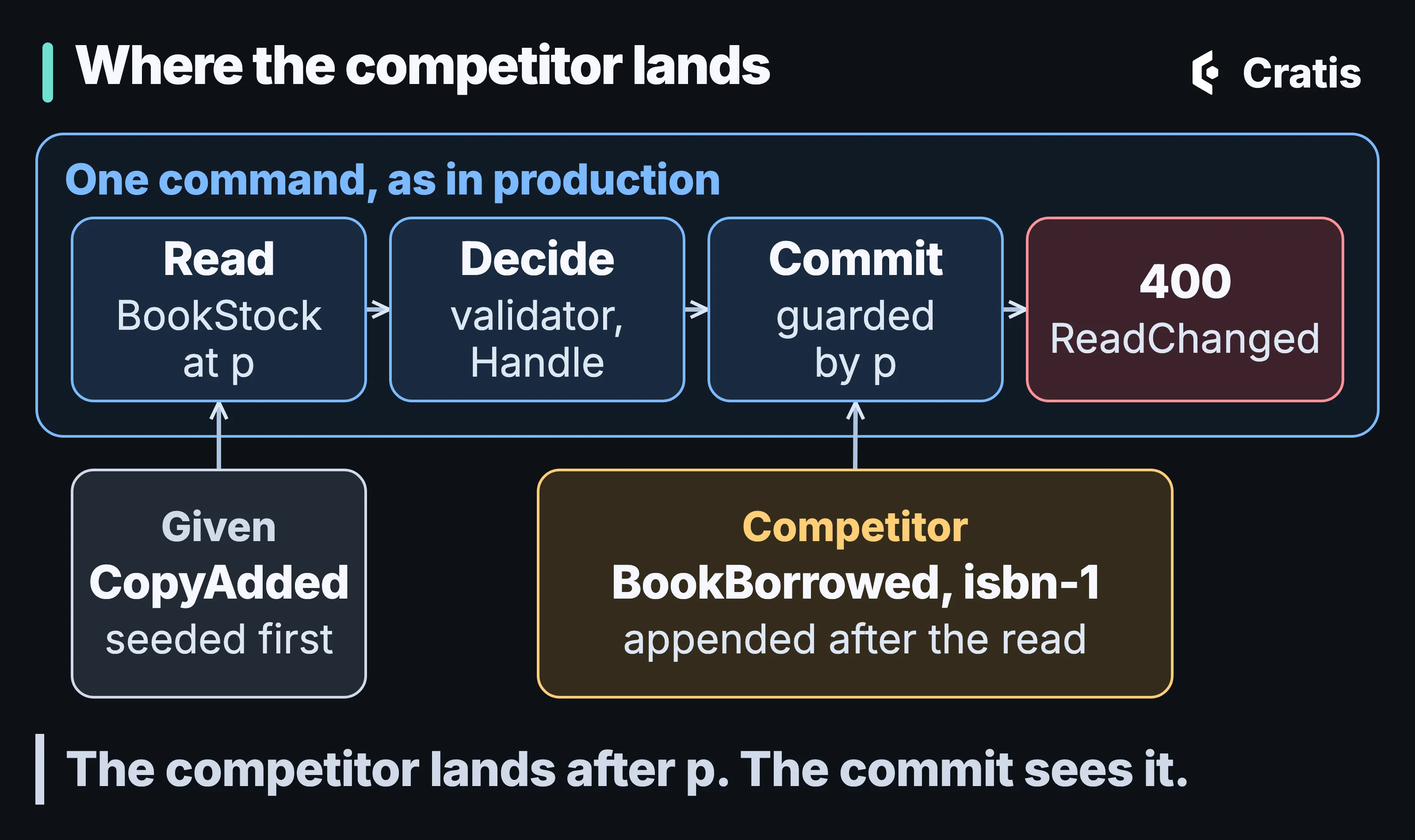
The seeded events are there before the read. The competitor lands between the read and the commit.
This is the test that changes when the mode changes. Compile the same command with read protection Off and run the same test: the command succeeds, its BookBorrowed is appended next to the competitor’s, and the assertion on ConcurrencyViolation fails. That failure is the test doing its job. It says the rule isn’t guarded.
What the scenario sets up for you
Section titled “What the scenario sets up for you”There’s no setup in that test beyond new CommandScenario<BorrowBook>(). The scenario looks at the command first. When it runs under read protection On or Measure, is marked [ProtectedDecision], or takes a decision dependency (DecisionRead<T>, IDecisionReads, IStreamReads, StreamDecision, or a per-stream read model), the scenario uses one real in-process Chronicle event log for everything: the seeded events, the guarded reads, the competitor and the command’s commit. The read and the commit see the same history, which is what makes the race real.
Older tests may call UseDecisionReads() to get that log. It isn’t needed anymore. It’s hidden from IntelliSense and kept so those tests compile.
The mode comes from the assembly that declares the command, or from [ReadProtection(...)] on the command, as in production. The test project doesn’t set anything. If the command’s project says On, the test runs under On.
Two things change in that mode:
scenario.EventScenariothrowsEventScenarioUnavailableInDecisionMode. It belongs to a separate log that the command’s reads would never see. Seed withGiven.ForEventSource(...).Events(...).scenario.EventLogpoints at the shared log, and it holds everything: seeds, competitors and commits.- Seeding on a route,
Given.ForEventSource(...).OnRoute(route).Events(...), needs this log. Outside it, routed seeding throws.
Measure selects the same log, but it doesn’t add a guard. A command under Measure returns what it would return under Off, so the race test fails under Measure just as it does under Off. Measure reports what On would do; it doesn’t do it. Test the command in the mode it runs in.
Seed events, not read models
Section titled “Seed events, not read models”Command scenarios can also pin a read model instead of deriving it from events:
scenario.Given.ForEventSource(isbn).ReadModel(new BookStock(isbn, 1));Under On that doesn’t do what it looks like. A guarded read always folds the event log, as it does in production, and never sees a pinned instance. With that pin and no events, the validator gets null and the command is refused with “No copies of this book are available.” A pinned instance serves only the reads that don’t guard the decision, such as a read marked [Unprotected]. For a [ProtectedDecision] command that takes the model as a DecisionRead<T>, pinning it throws PinnedReadModelCannotProvideDecisionToken.
So seed the events that produce the state. For a guarded read they’re the only way to supply it, and they test the projection as well.
Two keys
Section titled “Two keys”Part 3’s BorrowBook reads two models, BookStock for the book and MemberLoans for the member, and appends one event to each in one batch. Each read guards its own key, so a competing write on either key must refuse the whole borrow. This test competes on the member: two loans are taken, a third arrives after the read, and the borrow would have been the fourth.
using Cratis.Arc.Chronicle.Testing.Commands;using Cratis.Arc.Testing.Commands;using Cratis.Arc.Validation;using Xunit;
public class when_the_member_takes_another_loan_first{    [Fact]    public async Task the_whole_borrow_is_refused()    {        await using var scenario = new CommandScenario<BorrowBook>();        var isbn = new Isbn("isbn-1");        var member = new MemberId("member-1");        scenario.Given.ForEventSource(isbn).Events(new CopyAdded());        scenario.Given.ForEventSource(member).Events(new LoanTaken(new Isbn("isbn-2")), new LoanTaken(new Isbn("isbn-3")));        scenario.AppendConcurrently(member, new LoanTaken(new Isbn("isbn-4")));
        var result = await scenario.Execute(new BorrowBook(isbn, member));
        result.ShouldHaveValidationErrorBecauseOf(ValidationResultReason.ConcurrencyViolation);        Assert.Empty(scenario.AppendedEvents);    }}
The message names the model and the key that changed:
MemberLoans 'member-1' changed after BorrowBook read it. Nothing from this command was written; submit it again.Neither the book’s BookBorrowed nor the member’s LoanTaken is written. Write the same test with the competitor on the book, a BookBorrowed for isbn-1, and it’s refused too. One test per key you read is the way to find a key that isn’t guarded, for example a model that is read through a key other than the one you expected.
One month
Section titled “One month”Part 4’s withdrawal limit reads MonthlyWithdrawals from one month’s stream. The competitor has to land on the same route for the test to mean anything, so seed and compete on the route, not just the account:
using Cratis.Arc.Chronicle.Testing.Commands;using Cratis.Arc.Testing.Commands;using Cratis.Arc.Validation;using Xunit;
public class when_another_withdrawal_lands_while_withdrawing{    [Fact]    public async Task in_the_same_month_it_is_refused()    {        await using var scenario = new CommandScenario<Withdraw>();        var account = new AccountId("account-1");        var october = scenario.EventRoutes.For<BankAccountEventSource>("Transactions").WithStreamId("2026-10");        scenario.Given.ForEventSource(account).OnRoute(october).Events(new MoneyWithdrawn(4000m));        scenario.AppendConcurrently(account, october, new MoneyWithdrawn(500m));
        var result = await scenario.Execute(new Withdraw(account, "2026-10", 500m));
        result.ShouldHaveValidationErrorBecauseOf(ValidationResultReason.ConcurrencyViolation);        Assert.Empty(scenario.AppendedEvents);    }
    [Fact]    public async Task in_another_month_it_goes_through()    {        await using var scenario = new CommandScenario<Withdraw>();        var account = new AccountId("account-1");        var transactions = scenario.EventRoutes.For<BankAccountEventSource>("Transactions");        scenario.Given.ForEventSource(account).OnRoute(transactions.WithStreamId("2026-10")).Events(new MoneyWithdrawn(4000m));        scenario.AppendConcurrently(account, transactions.WithStreamId("2026-11"), new MoneyWithdrawn(500m));
        var result = await scenario.Execute(new Withdraw(account, "2026-10", 500m));
        result.ShouldBeSuccessful();        await scenario.ShouldHaveAppendedEvent<Withdraw, MoneyWithdrawn>(account);    }}
scenario.EventRoutes resolves a route from the event source definitions the scenario discovered, so For<BankAccountEventSource>("Transactions") is the same stream type the command is routed to, and WithStreamId("2026-10") is the month. OnRoute seeds there, and the AppendConcurrently overload that takes a route makes the competitor land there.
The second test is the one people skip. It checks that the guard isn’t wider than the rule: a withdrawal in November doesn’t touch October’s total, so it mustn’t refuse an October withdrawal. Part 4 showed how a whole-account read next to the monthly one widens the guard to every month. A test like this is how you’d notice. The same goes for the library: a borrow of another book, or a BookRenamed on the same book, which BookStock doesn’t fold, should leave the command alone.
Without Arc
Section titled “Without Arc”When you call Chronicle directly, as in Part 8, the race test has the same shape without a scenario: take the decision read, append a competing event, then do the guarded append and check that it was refused. Chronicle’s Test the race scenario shows it in C# and Elixir.
If the code runs in a unit of work with read protection enforced, you can also check what was guarded. After the commit, unitOfWork.GetAppendConditions() (namespace Cratis.Chronicle.Transactions) returns one AppendCondition per guarded source, with its event types, stream values, position and the origins behind it. Assert on the origins and the number of conditions rather than on their text. See what a commit guarded in Chronicle’s docs has the example. Part 10 is about how those conditions are built.
What a green race test does not show
Section titled “What a green race test does not show”A race test checks one interleaving: one competitor, at one point, after the read and before the commit. It shows the guard covers that event on that key. It doesn’t show:
- Timing or load. The log is Chronicle’s in-process store for tests, not a Chronicle server or its storage. A green test says nothing about how the guard behaves under contention or what it costs.
- Writers that don’t guard their own decision. Your command detects a matching event from any writer. A command elsewhere that reads plainly, under
Off, through[Unprotected]or with an immediate append, can still break the rule with its own decision. - What’s outside every guard.
ReviseandRedact, projection definitions changed by another process, services, other databases and other event sequences. - The mode in production. The test runs in the mode compiled into the command’s assembly. A runtime cap,
ReadProtection:MaximumMode, can lower it on a host. Part 6 covers that.
The reference is Arc’s Test the race, and Testing Chronicle commands covers the scenario’s decision mode in full, including how reads that don’t guard the decision are resolved.
The examples need Arc 22.108.0 or later and Chronicle 19.71.0 or later.