

Stop filtering on status

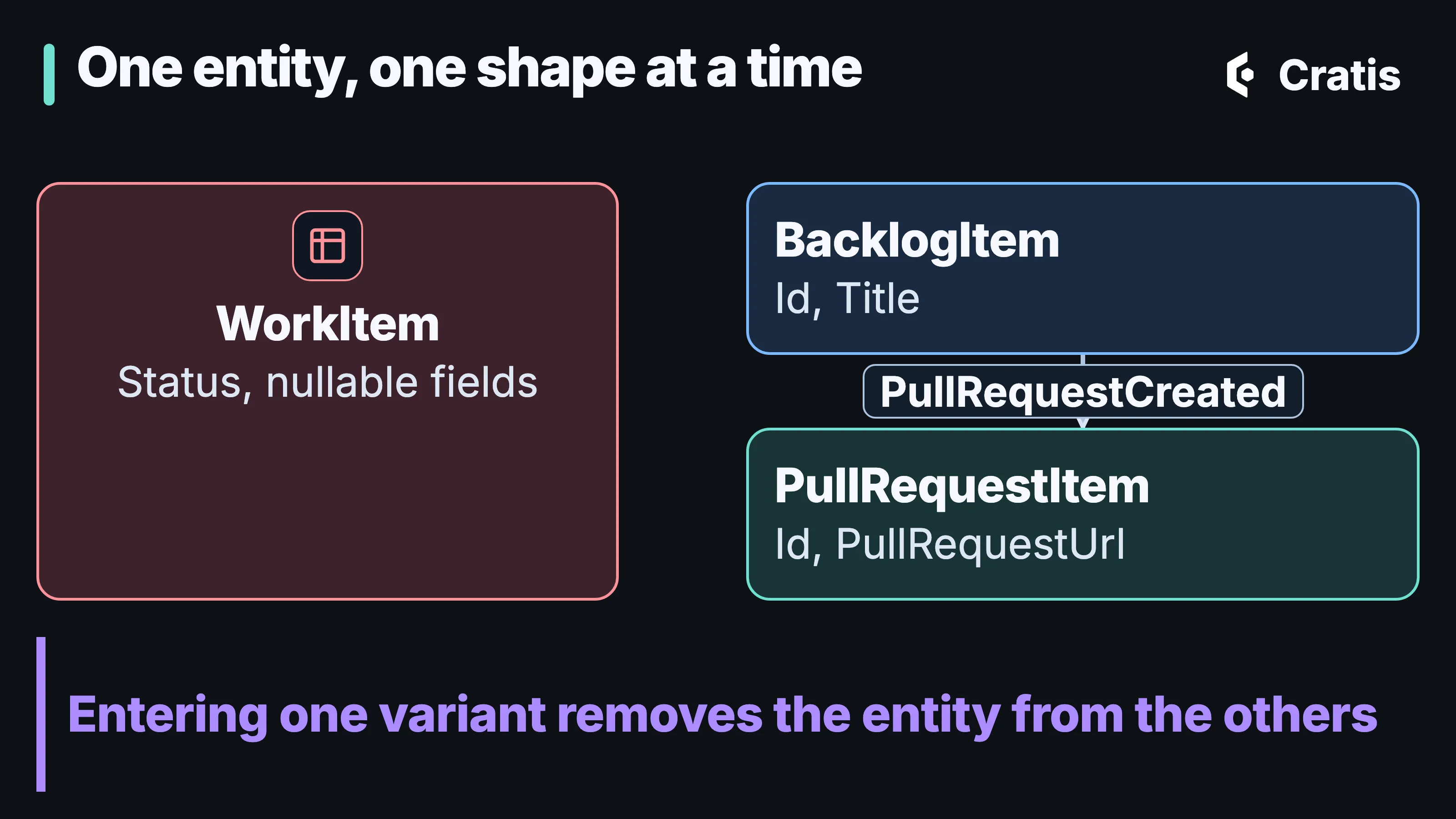
Almost every read model starts out innocent. A work item has a title, so you add a Title. Then it needs to know whether it’s still a backlog entry or has become a pull request, so you add a Status. Then pull requests have a URL, and builds have a result, and suddenly you have a record where half the properties are nullable and every query begins with “first, filter on status, then you can trust the rest”.
Let’s face it, that’s the shape of the data fighting the shape of the model. A backlog entry and a pull request are different things an entity is at different times, and often they have different properties. Sometimes they hardly differ at all, and the Status filter is still the cost you pay on every query. I wrote about the declarative side of projections in Keep the projection out of the model. This post is about a feature that works in both styles, and that I like a lot: variants.
- A variant group is a set of read models for the same logical entity, where the entity is in exactly one of them at a time.
- Each variant has the properties its stage needs. No
Status, no nullable leftovers. Stages can differ a lot or hardly at all. - When an entity enters one variant, Chronicle removes it from the others. You don’t write the removal.
- Only the variant’s entering event can create it. Any other event it listens to can only update an instance that already exists, so a late or replayed event can’t resurrect something that has moved on.
- It works with model-bound attributes and with the fluent builder. The fluent one has no equivalent of
[GlobalFor<T>]. - Each variant is its own collection or table, and nothing queries across the group for you.
One entity, several shapes
Section titled “One entity, several shapes”The documentation uses a work item that is a backlog entry until a pull request exists for it, and then a pull request. Modeled as one read model, you get the Status problem from the intro. With variants, you declare one read model per stage instead.
Two things make that work. First, every variant points at the same identity type, which is what ties them into a group. Second, each variant names the event that enters it. Here it is with model-bound attributes. As in the last post, the tabs are synced, so pick your language once.
using Cratis.Chronicle.Events;using Cratis.Chronicle.Keys;using Cratis.Chronicle.Projections.ModelBound;
[EventType]public record IssueCreated(string Title);
[EventType]public record PullRequestCreated(string PullRequestUrl);
/// <summary>/// Anchors the logical identity shared by every variant. It does not need to be a/// read model itself, and it does not need a common CLR base type with any of the variants./// </summary>public class WorkItem;
[VariantOf<WorkItem>][EntersOn<IssueCreated>]public record BacklogItem([property: Key] Guid Id, string Title);
[VariantOf<WorkItem>][EntersOn<PullRequestCreated>]public record PullRequestItem([property: Key] Guid Id, [property: SetFrom<PullRequestCreated>] string PullRequestUrl);
import io.cratis.chronicle.events.EventTypeimport io.cratis.chronicle.projections.EntersOnimport io.cratis.chronicle.projections.FromEventimport io.cratis.chronicle.projections.FromEventSourceIdimport io.cratis.chronicle.projections.SetFromimport io.cratis.chronicle.projections.VariantOfimport io.cratis.chronicle.readModels.ReadModel
@EventTypedata class IssueCreated(val title: String)
@EventTypedata class PullRequestCreated(val pullRequestUrl: String)
/** * Anchors the logical identity shared by every variant. It does not need to be a read model * itself, and it does not need a common supertype with any of the variants. */class WorkItem
@ReadModel@VariantOf(WorkItem::class, key = "id")@EntersOn(IssueCreated::class)@FromEvent(IssueCreated::class)data class BacklogItem( @FromEventSourceId val id: String = "",
@SetFrom("title", IssueCreated::class) val title: String = "")
@ReadModel@VariantOf(WorkItem::class, key = "id")@EntersOn(PullRequestCreated::class)@FromEvent(PullRequestCreated::class)data class PullRequestItem( @FromEventSourceId val id: String = "",
@SetFrom("pullRequestUrl", PullRequestCreated::class) val pullRequestUrl: String = "")import io.cratis.chronicle.events.EventType;import io.cratis.chronicle.projections.EntersOn;import io.cratis.chronicle.projections.FromEvent;import io.cratis.chronicle.projections.FromEventSourceId;import io.cratis.chronicle.projections.SetFrom;import io.cratis.chronicle.projections.VariantOf;import io.cratis.chronicle.readModels.ReadModel;
@EventTyperecord IssueCreated(String title) {}
@EventTyperecord PullRequestCreated(String pullRequestUrl) {}
/** * Anchors the logical identity shared by every variant. It does not need to be a read model * itself, and it does not need a common supertype with any of the variants. */class WorkItem {}
@ReadModel@VariantOf(identity = WorkItem.class, key = "id")@EntersOn(eventType = IssueCreated.class)@FromEvent(eventType = IssueCreated.class)class BacklogItem { @FromEventSourceId public String id = "";
@SetFrom(propertyPath = "title", eventType = IssueCreated.class) public String title = "";}
@ReadModel@VariantOf(identity = WorkItem.class, key = "id")@EntersOn(eventType = PullRequestCreated.class)@FromEvent(eventType = PullRequestCreated.class)class PullRequestItem { @FromEventSourceId public String id = "";
@SetFrom(propertyPath = "pullRequestUrl", eventType = PullRequestCreated.class) public String pullRequestUrl = "";}defmodule MyApp.Events.IssueCreated do use Chronicle.Events.EventType, id: "issue-created-v1"
defstruct [:title]end
defmodule MyApp.Events.PullRequestCreated do use Chronicle.Events.EventType, id: "pull-request-created-v1"
defstruct [:pull_request_url]end
# Anchors the logical identity shared by every variant. It does not need to be a read model# itself, and it does not need a common shape with any of the variants.defmodule MyApp.ReadModels.WorkItem doend
defmodule MyApp.ReadModels.BacklogItem do use Chronicle.ReadModels.ReadModel
alias MyApp.Events.IssueCreated alias MyApp.ReadModels.WorkItem
defstruct [:id, :title]
variant_of WorkItem, key: :id enters_on IssueCreated
from IssueCreated, set: [id: :event_source_id, title: :title]end
defmodule MyApp.ReadModels.PullRequestItem do use Chronicle.ReadModels.ReadModel
alias MyApp.Events.PullRequestCreated alias MyApp.ReadModels.WorkItem
defstruct [:id, :pull_request_url]
variant_of WorkItem, key: :id enters_on PullRequestCreated
from PullRequestCreated, set: [id: :event_source_id, pull_request_url: :pull_request_url]endimport { entersOn, eventType, fromEvent, setFrom, variantOf } from '@cratis/chronicle';
@eventType()export class IssueCreated { title = '';}
@eventType()export class PullRequestCreated { pullRequestUrl = '';}
/** * Anchors the logical identity shared by every variant. It does not need to be a read model * itself, and it does not need a common shape with any of the variants. */export class WorkItem {}
@variantOf(WorkItem, 'id')@entersOn(IssueCreated)@fromEvent(IssueCreated)export class BacklogItem { id = '';
@setFrom(IssueCreated, 'title') title = '';}
@variantOf(WorkItem, 'id')@entersOn(PullRequestCreated)@fromEvent(PullRequestCreated)export class PullRequestItem { id = '';
@setFrom(PullRequestCreated, 'pullRequestUrl') pullRequestUrl = '';}WorkItem is only an anchor. It doesn’t have to be a read model, and it doesn’t need a common base type with the variants. Its job is to be the shared type that every variant in the group points at, which is why the docs suggest choosing one that means something on its own, rather than a marker with no purpose beyond grouping.
Now follow an entity through it. When IssueCreated is processed, a BacklogItem is created, and Title maps by convention just like in any other projection. When PullRequestCreated is processed for the same entity, a PullRequestItem is created and the BacklogItem for that entity is removed. There’s no RemovedWith anywhere. The group takes care of it. Variants aren’t required to be entered in any particular order, only to be mutually exclusive once entered, so a PullRequestCreated for an entity that was never a backlog item still creates a PullRequestItem.
A third variant for a later stage, say a closed work item, would be declared the same way, with its own entering event.
Here is what that says in specifications. First, an issue makes a backlog item:
using Cratis.Chronicle.Events;using Cratis.Chronicle.Keys;using Cratis.Chronicle.Testing.ReadModels;using Cratis.Specifications;using Xunit;
public class when_an_issue_is_created : Specification{    readonly EventSourceId _workItemId = EventSourceId.New();    readonly ReadModelScenario<BacklogItem> _backlog = new();
    Task Because() => _backlog.Given.ForEventSource(_workItemId).Events(new IssueCreated("Fix the login redirect"));
    [Fact] void should_be_in_the_backlog() => _backlog.Instance!.Title.ShouldEqual("Fix the login redirect");}
Then a pull request for the same work item, with one ReadModelScenario per variant fed the same history:
using Cratis.Chronicle.Events;using Cratis.Chronicle.Keys;using Cratis.Chronicle.Testing.ReadModels;using Cratis.Specifications;using Xunit;
public class when_a_pull_request_is_created_for_a_backlog_item : Specification{    readonly EventSourceId _workItemId = EventSourceId.New();    readonly ReadModelScenario<BacklogItem> _backlog = new();    readonly ReadModelScenario<PullRequestItem> _pullRequest = new();
    async Task Because()    {        object[] history = [new IssueCreated("Fix the login redirect"), new PullRequestCreated("https://example.com/pull/42")];
        await _backlog.Given.ForEventSource(_workItemId).Events(history);        await _pullRequest.Given.ForEventSource(_workItemId).Events(history);    }
    [Fact] void should_no_longer_be_in_the_backlog() => (_backlog.Instance is null).ShouldBeTrue();    [Fact] void should_be_a_pull_request() => _pullRequest.Instance!.PullRequestUrl.ShouldEqual("https://example.com/pull/42");}
There’s a nice property hiding in how this is built. Each variant compiles to an ordinary, independent projection definition, and the release that introduced variants made no kernel, wire or storage changes. So there’s nothing new to operate. A variant is a projection like any other, and the engine does the exclusion.
Only the entering event can create a variant
Section titled “Only the entering event can create a variant”Variants rarely listen to one event. A pull request also wants to know how its build went. You declare that exactly as you would on any projection, with SetFrom in the model-bound case. The one difference is what that mapping is allowed to do: it can update a variant that already exists, but it can never create one.
using Cratis.Chronicle.Events;using Cratis.Chronicle.Keys;using Cratis.Chronicle.Projections.ModelBound;
[EventType]public record PullRequestCreated(string PullRequestUrl);
[EventType]public record BuildCompleted(string BuildStatus);
public class WorkItem;
/// <summary>/// BuildStatus is mapped from BuildCompleted - an event that is NOT this/// variant's entering event, so it is automatically reclassified into an update-only join. It can bring/// an already-active instance up to date, but it can never create one on its own./// </summary>[VariantOf<WorkItem>][EntersOn<PullRequestCreated>]public record PullRequestItem(    [property: Key] Guid Id,    [property: SetFrom<PullRequestCreated>] string PullRequestUrl,    [property: SetFrom<BuildCompleted>] string BuildStatus);
import io.cratis.chronicle.events.EventTypeimport io.cratis.chronicle.projections.EntersOnimport io.cratis.chronicle.projections.FromEventimport io.cratis.chronicle.projections.FromEventSourceIdimport io.cratis.chronicle.projections.SetFromimport io.cratis.chronicle.projections.VariantOfimport io.cratis.chronicle.readModels.ReadModel
@EventTypedata class PullRequestCreated(val pullRequestUrl: String)
@EventTypedata class BuildCompleted(val buildStatus: String)
class WorkItem
/** * buildStatus is mapped from BuildCompleted - an event that is NOT this variant's * entering event, so it is automatically reclassified into an update-only join. It can bring an * already-active instance up to date, but it can never create one on its own. */@ReadModel@VariantOf(WorkItem::class, key = "id")@EntersOn(PullRequestCreated::class)@FromEvent(PullRequestCreated::class)@FromEvent(BuildCompleted::class)data class PullRequestItem( @FromEventSourceId val id: String = "",
@SetFrom("pullRequestUrl", PullRequestCreated::class) val pullRequestUrl: String = "",
@SetFrom("buildStatus", BuildCompleted::class) val buildStatus: String = "")import io.cratis.chronicle.events.EventType;import io.cratis.chronicle.projections.EntersOn;import io.cratis.chronicle.projections.FromEvent;import io.cratis.chronicle.projections.FromEventSourceId;import io.cratis.chronicle.projections.SetFrom;import io.cratis.chronicle.projections.VariantOf;import io.cratis.chronicle.readModels.ReadModel;
@EventTyperecord PullRequestCreated(String pullRequestUrl) {}
@EventTyperecord BuildCompleted(String buildStatus) {}
class WorkItem {}
/** * buildStatus is mapped from BuildCompleted - an event that is NOT this variant's * entering event, so it is automatically reclassified into an update-only join. It can bring an * already-active instance up to date, but it can never create one on its own. */@ReadModel@VariantOf(identity = WorkItem.class, key = "id")@EntersOn(eventType = PullRequestCreated.class)@FromEvent(eventType = PullRequestCreated.class)@FromEvent(eventType = BuildCompleted.class)class PullRequestItem { @FromEventSourceId public String id = "";
@SetFrom(propertyPath = "pullRequestUrl", eventType = PullRequestCreated.class) public String pullRequestUrl = "";
@SetFrom(propertyPath = "buildStatus", eventType = BuildCompleted.class) public String buildStatus = "";}defmodule MyApp.Events.PullRequestCreated do use Chronicle.Events.EventType, id: "pull-request-created-v1"
defstruct [:pull_request_url]end
defmodule MyApp.Events.BuildCompleted do use Chronicle.Events.EventType, id: "build-completed-v1"
defstruct [:build_status]end
defmodule MyApp.ReadModels.WorkItem doend
# build_status is mapped from BuildCompleted - an event that is NOT this# variant's entering event, so it is automatically reclassified into an update-only join. It can# bring an already-active instance up to date, but it can never create one on its own.defmodule MyApp.ReadModels.PullRequestItem do use Chronicle.ReadModels.ReadModel
alias MyApp.Events.{PullRequestCreated, BuildCompleted} alias MyApp.ReadModels.WorkItem
defstruct [:id, :pull_request_url, :build_status]
variant_of WorkItem, key: :id enters_on PullRequestCreated
from PullRequestCreated, set: [id: :event_source_id, pull_request_url: :pull_request_url]
from BuildCompleted, set: [build_status: :build_status]endimport { entersOn, eventType, fromEvent, setFrom, variantOf } from '@cratis/chronicle';
@eventType()export class PullRequestCreated { pullRequestUrl = '';}
@eventType()export class BuildCompleted { buildStatus = '';}
export class WorkItem {}
/** * buildStatus is mapped from BuildCompleted - an event that is NOT this variant's * entering event, so it is automatically reclassified into an update-only join. It can bring an * already-active instance up to date, but it can never create one on its own. */@variantOf(WorkItem, 'id')@entersOn(PullRequestCreated)@fromEvent(PullRequestCreated)@fromEvent(BuildCompleted)export class PullRequestItem { id = '';
@setFrom(PullRequestCreated, 'pullRequestUrl') pullRequestUrl = '';
@setFrom(BuildCompleted, 'buildStatus') buildStatus = '';}BuildStatus is mapped from BuildCompleted, which isn’t the event named in EntersOn. Chronicle reclassifies that mapping into an update-only join on the variant’s own key before it ever reaches the projection engine. The entering event stays the only door in.
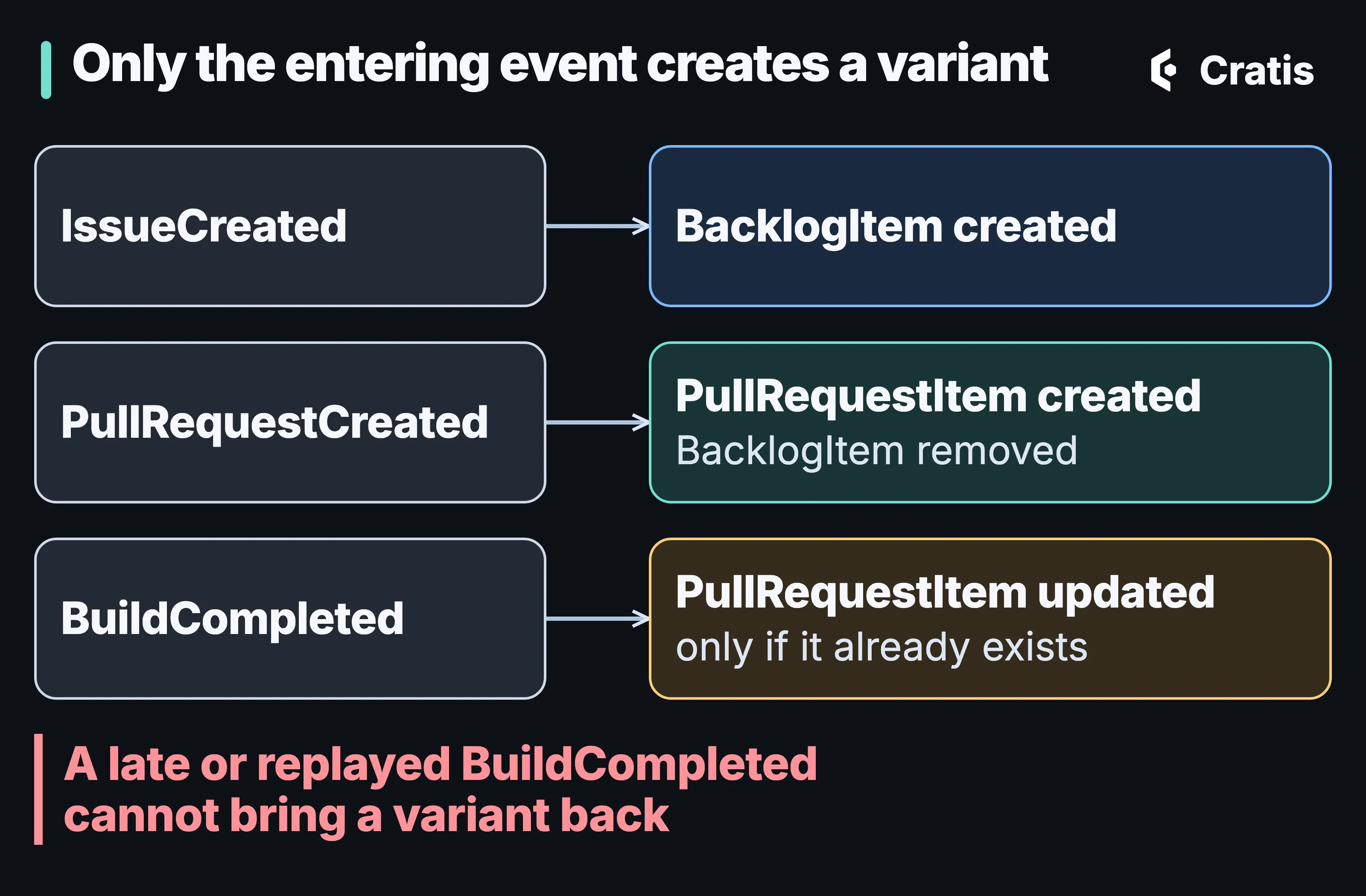
The docs explain why this matters, and it’s the part of the feature I find most convincing. Without that reclassification, a BuildCompleted that arrives out of order, or is replayed, could resurrect a PullRequestItem for an entity that has since moved on to another variant, or one that was never a pull request at all. That’s exactly the bug a status column invites, and here it’s structurally impossible. You don’t have to reason about event ordering to get the guarantee. Declaring the entering event gives it to you.
You can see that in specifications too. A build for something that never became a pull request creates nothing:
using Cratis.Chronicle.Events;using Cratis.Chronicle.Keys;using Cratis.Chronicle.Testing.ReadModels;using Cratis.Specifications;using Xunit;
public class when_a_build_completes_for_something_that_is_not_a_pull_request : Specification{    readonly EventSourceId _workItemId = EventSourceId.New();    readonly ReadModelScenario<PullRequestItem> _pullRequest = new();
    Task Because() => _pullRequest.Given.ForEventSource(_workItemId).Events(new BuildCompleted("passed"));
    [Fact] void should_not_create_a_pull_request() => (_pullRequest.Instance is null).ShouldBeTrue();}
And when the pull request exists, the build status lands on it:
using Cratis.Chronicle.Events;using Cratis.Chronicle.Keys;using Cratis.Chronicle.Testing.ReadModels;using Cratis.Specifications;using Xunit;
public class when_a_build_completes_after_the_pull_request_was_created : Specification{    readonly EventSourceId _workItemId = EventSourceId.New();    readonly ReadModelScenario<PullRequestItem> _pullRequest = new();
    Task Because() => _pullRequest.Given.ForEventSource(_workItemId).Events(        new PullRequestCreated("https://example.com/pull/42"),        new BuildCompleted("passed"));
    [Fact] void should_report_the_build_status() => _pullRequest.Instance!.BuildStatus.ShouldEqual("passed");}
So what about a build that finishes before the pull request exists? The first spec says it creates nothing, and that holds. What happens once the pull request does arrive is more interesting. BuildStatus is mapped through a join, and joins are re-resolved against the last stored event of the joined stream whenever the projection handles one of the read model’s own events. So the earlier BuildCompleted is picked up the moment PullRequestCreated creates the variant:
using Cratis.Chronicle.Events;using Cratis.Chronicle.Keys;using Cratis.Chronicle.Testing.ReadModels;using Cratis.Specifications;using Xunit;
public class when_a_build_completes_before_the_pull_request_was_created : Specification{    readonly EventSourceId _workItemId = EventSourceId.New();    readonly ReadModelScenario<PullRequestItem> _pullRequest = new();
    Task Because() => _pullRequest.Given.ForEventSource(_workItemId).Events(        new BuildCompleted("passed"),        new PullRequestCreated("https://example.com/pull/42"));
    [Fact] void should_still_create_the_pull_request() => _pullRequest.Instance!.PullRequestUrl.ShouldEqual("https://example.com/pull/42");    [Fact] void should_pick_up_the_build_status_reported_before_entering() => _pullRequest.Instance!.BuildStatus.ShouldEqual("passed");}
If your build can really finish before the pull request exists, that’s still worth a thought about your events, but the projection won’t lose the result.
Sharing a mapping across variants
Section titled “Sharing a mapping across variants”Some properties every stage wants. A title is the obvious one. Repeating the mapping on each variant gets old, so model-bound projections have [GlobalFor<TIdentity>]: declare the mapping once, and it’s merged into every variant in the group. Each client spells it its own way, and the model-bound variants page has all five.
using Cratis.Chronicle.Events;using Cratis.Chronicle.Keys;using Cratis.Chronicle.Projections.ModelBound;
[EventType]public record IssueCreated(string Title);

[EventType]public record PullRequestCreated(string PullRequestUrl);

[EventType]public record TitleChanged(string Title);

public class WorkItem;

[VariantOf<WorkItem>][EntersOn<IssueCreated>]public record BacklogItem([property: Key] Guid Id, string Title);

[VariantOf<WorkItem>][EntersOn<PullRequestCreated>]public record PullRequestItem(    [property: Key] Guid Id,    string Title,    [property: SetFrom<PullRequestCreated>] string PullRequestUrl);

/// <summary>/// Declares a mapping every variant of WorkItem shares. Every variant must have a/// Title member - one that does not is a declaration error, not a silently skipped mapping./// </summary>/// <param name="Title">The title every variant carrying one keeps up to date.</param>[GlobalFor<WorkItem>]public record SharedHandlers([property: SetFrom<TitleChanged>] string Title);
import io.cratis.chronicle.events.EventTypeimport io.cratis.chronicle.projections.EntersOnimport io.cratis.chronicle.projections.FromEventimport io.cratis.chronicle.projections.FromEventSourceIdimport io.cratis.chronicle.projections.GlobalForimport io.cratis.chronicle.projections.SetFromimport io.cratis.chronicle.projections.VariantOfimport io.cratis.chronicle.readModels.ReadModel
@EventTypedata class IssueCreated(val title: String)
@EventTypedata class PullRequestCreated(val pullRequestUrl: String)
@EventTypedata class TitleChanged(val title: String)
class WorkItem
@ReadModel@VariantOf(WorkItem::class, key = "id")@EntersOn(IssueCreated::class)@FromEvent(IssueCreated::class)data class BacklogItem( @FromEventSourceId val id: String = "", val title: String = "")
@ReadModel@VariantOf(WorkItem::class, key = "id")@EntersOn(PullRequestCreated::class)@FromEvent(PullRequestCreated::class)data class PullRequestItem( @FromEventSourceId val id: String = "", val title: String = "",
@SetFrom("pullRequestUrl", PullRequestCreated::class) val pullRequestUrl: String = "")
/** * Declares a mapping every variant of WorkItem shares. Every variant must have a * title member - one that does not is a declaration error, not a silently skipped mapping. */@GlobalFor(WorkItem::class)@FromEvent(TitleChanged::class)data class SharedHandlers( @SetFrom("title", TitleChanged::class) val title: String = "")import io.cratis.chronicle.events.EventType;import io.cratis.chronicle.projections.EntersOn;import io.cratis.chronicle.projections.FromEvent;import io.cratis.chronicle.projections.FromEventSourceId;import io.cratis.chronicle.projections.GlobalFor;import io.cratis.chronicle.projections.SetFrom;import io.cratis.chronicle.projections.VariantOf;import io.cratis.chronicle.readModels.ReadModel;
@EventTyperecord IssueCreated(String title) {}
@EventTyperecord PullRequestCreated(String pullRequestUrl) {}
@EventTyperecord TitleChanged(String title) {}
class WorkItem {}
@ReadModel@VariantOf(identity = WorkItem.class, key = "id")@EntersOn(eventType = IssueCreated.class)@FromEvent(eventType = IssueCreated.class)class BacklogItem { @FromEventSourceId public String id = ""; public String title = "";}
@ReadModel@VariantOf(identity = WorkItem.class, key = "id")@EntersOn(eventType = PullRequestCreated.class)@FromEvent(eventType = PullRequestCreated.class)class PullRequestItem { @FromEventSourceId public String id = ""; public String title = "";
@SetFrom(propertyPath = "pullRequestUrl", eventType = PullRequestCreated.class) public String pullRequestUrl = "";}
/** * Declares a mapping every variant of WorkItem shares. Every variant must have a * title member - one that does not is a declaration error, not a silently skipped mapping. */@GlobalFor(identity = WorkItem.class)@FromEvent(eventType = TitleChanged.class)class SharedHandlers { @SetFrom(propertyPath = "title", eventType = TitleChanged.class) public String title = "";}defmodule MyApp.Events.IssueCreated do use Chronicle.Events.EventType, id: "issue-created-v1"
defstruct [:title]end
defmodule MyApp.Events.PullRequestCreated do use Chronicle.Events.EventType, id: "pull-request-created-v1"
defstruct [:pull_request_url]end
defmodule MyApp.Events.TitleChanged do use Chronicle.Events.EventType, id: "title-changed-v1"
defstruct [:title]end
defmodule MyApp.ReadModels.WorkItem doend
defmodule MyApp.ReadModels.BacklogItem do use Chronicle.ReadModels.ReadModel
alias MyApp.Events.IssueCreated alias MyApp.ReadModels.WorkItem
defstruct [:id, :title]
variant_of WorkItem, key: :id enters_on IssueCreated
from IssueCreated, set: [id: :event_source_id]end
defmodule MyApp.ReadModels.PullRequestItem do use Chronicle.ReadModels.ReadModel
alias MyApp.Events.PullRequestCreated alias MyApp.ReadModels.WorkItem
defstruct [:id, :title, :pull_request_url]
variant_of WorkItem, key: :id enters_on PullRequestCreated
from PullRequestCreated, set: [id: :event_source_id, pull_request_url: :pull_request_url]end
# Declares a mapping every variant of WorkItem shares. Every variant must have a# title member - one that does not is a declaration error, not a silently skipped mapping. Never# registered as a projection on its own.defmodule MyApp.Projections.SharedHandlers do use Chronicle.Projections.GlobalHandler, identity: MyApp.ReadModels.WorkItem
alias MyApp.Events.TitleChanged
from TitleChanged, set: [title: :title]endimport { entersOn, eventType, fromEvent, globalFor, setFrom, variantOf } from '@cratis/chronicle';
@eventType()export class IssueCreated { title = '';}
@eventType()export class PullRequestCreated { pullRequestUrl = '';}
@eventType()export class TitleChanged { title = '';}
export class WorkItem {}
@variantOf(WorkItem, 'id')@entersOn(IssueCreated)@fromEvent(IssueCreated)export class BacklogItem { id = ''; title = '';}
@variantOf(WorkItem, 'id')@entersOn(PullRequestCreated)@fromEvent(PullRequestCreated)export class PullRequestItem { id = ''; title = '';
@setFrom(PullRequestCreated, 'pullRequestUrl') pullRequestUrl = '';}
/** * Declares a mapping every variant of WorkItem shares. Every variant must have a * title member - one that does not is a declaration error, not a silently skipped mapping. Never * registered as a projection on its own. */@globalFor(WorkItem)export class SharedHandlers { @setFrom(TitleChanged, 'title') title = '';}This block is its own small example, with a fresh set of events. SharedHandlers is not a read model and no variant inherits from it. It only carries the mapping, and TitleChanged now updates the title on whichever variant the work item is in:
using Cratis.Chronicle.Events;using Cratis.Chronicle.Keys;using Cratis.Chronicle.Testing.ReadModels;using Cratis.Specifications;using Xunit;
public class when_the_title_changes_after_the_pull_request_was_created : Specification{    readonly EventSourceId _workItemId = EventSourceId.New();    readonly ReadModelScenario<PullRequestItem> _pullRequest = new();
    Task Because() => _pullRequest.Given.ForEventSource(_workItemId).Events(        new IssueCreated("Fix login"),        new PullRequestCreated("https://example.com/pull/42"),        new TitleChanged("Fix the login redirect"));
    [Fact] void should_have_the_new_title() => _pullRequest.Instance!.Title.ShouldEqual("Fix the login redirect");}
Like any other non-entering mapping, a shared one can only update an active variant, so it’s safe to share across stages that begin at different times. And every variant must have the member a shared mapping targets. A variant without it is a declaration error, caught when the projection is discovered, not an unpredictable surprise when a shared event finally shows up.
The same thing, fluent
Section titled “The same thing, fluent”Everything above is also available in the declarative style, and this is where the two styles from the last post line up one to one.
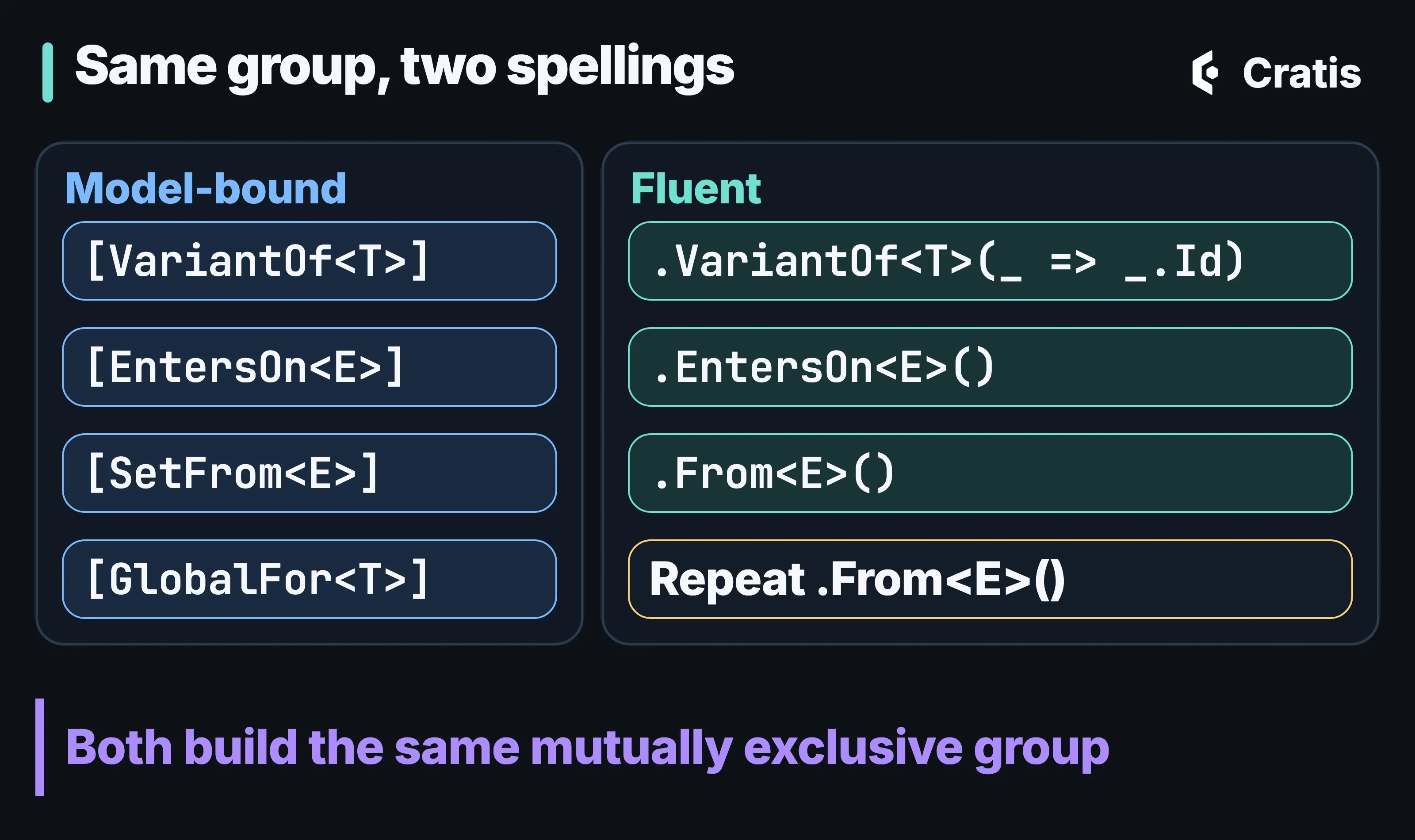
The read models are plain records, the projections say which group and which entering event, and the identity type is declared exactly as before.
using Cratis.Chronicle.Events;using Cratis.Chronicle.Projections;
[EventType]public record IssueCreated(string Title);
[EventType]public record PullRequestCreated(string PullRequestUrl);
/// <summary>/// Anchors the logical identity shared by BacklogItem and PullRequestItem./// Deliberately not a read model itself, and does not need a common CLR base type with either variant./// </summary>public class WorkItem;
public record BacklogItem(Guid Id, string Title);
public record PullRequestItem(Guid Id, string PullRequestUrl);
public class BacklogItemProjection : IProjectionFor<BacklogItem>{    public void Define(IProjectionBuilderFor<BacklogItem> builder) => builder        .VariantOf<WorkItem>(_ => _.Id)        .EntersOn<IssueCreated>();}
public class PullRequestItemProjection : IProjectionFor<PullRequestItem>{    public void Define(IProjectionBuilderFor<PullRequestItem> builder) => builder        .VariantOf<WorkItem>(_ => _.Id)        .EntersOn<PullRequestCreated>();}
import io.cratis.chronicle.events.EventTypeimport io.cratis.chronicle.projections.IProjectionBuilderForimport io.cratis.chronicle.projections.IProjectionFor
@EventTypedata class IssueCreated(val title: String)
@EventTypedata class PullRequestCreated(val pullRequestUrl: String)
/** * Anchors the logical identity shared by BacklogItem and PullRequestItem. * Deliberately not a read model itself, and does not need a common supertype with either variant. */class WorkItem
data class BacklogItem(val id: String = "", val title: String = "")
data class PullRequestItem(val id: String = "", val pullRequestUrl: String = "")
class BacklogItemProjection : IProjectionFor<BacklogItem> { override fun define(builder: IProjectionBuilderFor<BacklogItem>) { builder .variantOf(WorkItem::class, BacklogItem::id) .entersOn(IssueCreated::class) }}
class PullRequestItemProjection : IProjectionFor<PullRequestItem> { override fun define(builder: IProjectionBuilderFor<PullRequestItem>) { builder .variantOf(WorkItem::class, PullRequestItem::id) .entersOn(PullRequestCreated::class) }}import io.cratis.chronicle.events.EventType;import io.cratis.chronicle.projections.IProjectionBuilderFor;import io.cratis.chronicle.projections.IProjectionFor;
@EventTyperecord IssueCreated(String title) {}
@EventTyperecord PullRequestCreated(String pullRequestUrl) {}
/** * Anchors the logical identity shared by BacklogItem and PullRequestItem. * Deliberately not a read model itself, and does not need a common supertype with either variant. */class WorkItem {}
class BacklogItem { public String id = ""; public String title = "";}
class PullRequestItem { public String id = ""; public String pullRequestUrl = "";}
class BacklogItemProjection implements IProjectionFor<BacklogItem> { @Override public void define(IProjectionBuilderFor<BacklogItem> builder) { builder .variantOf(WorkItem.class, "id") .entersOn(IssueCreated.class); }}
class PullRequestItemProjection implements IProjectionFor<PullRequestItem> { @Override public void define(IProjectionBuilderFor<PullRequestItem> builder) { builder .variantOf(WorkItem.class, "id") .entersOn(PullRequestCreated.class); }}defmodule MyApp.Events.IssueCreated do use Chronicle.Events.EventType, id: "dec-variant-issue-created-v1"
defstruct [:title]end
defmodule MyApp.Events.PullRequestCreated do use Chronicle.Events.EventType, id: "dec-variant-pull-request-created-v1"
defstruct [:pull_request_url]end
# Anchors the logical identity shared by BacklogItem and PullRequestItem.# Deliberately not a read model itself, and does not need a common shape with either variant.defmodule MyApp.ReadModels.WorkItem doend
defmodule MyApp.ReadModels.BacklogItem do use Chronicle.ReadModels.ReadModel
defstruct [:id, :title]end
defmodule MyApp.ReadModels.PullRequestItem do use Chronicle.ReadModels.ReadModel
defstruct [:id, :pull_request_url]end
defmodule MyApp.Projections.BacklogItemProjection do use Chronicle.Projections.Projection, model: MyApp.ReadModels.BacklogItem
alias MyApp.Events.IssueCreated alias MyApp.ReadModels.WorkItem
variant_of WorkItem, key: :id enters_on IssueCreated
from IssueCreated, set: [id: :event_source_id, title: :title]end
defmodule MyApp.Projections.PullRequestItemProjection do use Chronicle.Projections.Projection, model: MyApp.ReadModels.PullRequestItem
alias MyApp.Events.PullRequestCreated alias MyApp.ReadModels.WorkItem
variant_of WorkItem, key: :id enters_on PullRequestCreated
from PullRequestCreated, set: [id: :event_source_id, pull_request_url: :pull_request_url]endimport { eventType } from '@cratis/chronicle';import { IProjectionBuilderFor, IProjectionFor, projection } from '@cratis/chronicle';
@eventType()class IssueCreated { title = '';}
@eventType()class PullRequestCreated { pullRequestUrl = '';}
/** * Anchors the logical identity shared by BacklogItem and PullRequestItem. * Deliberately not a read model itself, and does not need a common shape with either variant. */class WorkItem {}
class BacklogItem { id = ''; title = '';}
class PullRequestItem { id = ''; pullRequestUrl = '';}
@projection()class BacklogItemProjection implements IProjectionFor<BacklogItem> { define(builder: IProjectionBuilderFor<BacklogItem>): void { builder .variantOf(WorkItem, m => m.id) .entersOn(IssueCreated); }}
@projection()class PullRequestItemProjection implements IProjectionFor<PullRequestItem> { define(builder: IProjectionBuilderFor<PullRequestItem>): void { builder .variantOf(WorkItem, m => m.id) .entersOn(PullRequestCreated); }}VariantOf takes the identity type and a key accessor, and EntersOn names the entering event. Auto-mapping is on as in any fluent projection, so Title and PullRequestUrl map by name without a Set. Entering PullRequestItem removes the BacklogItem, again with no removal call, because the group is cross-wired automatically once every variant in it has been discovered.
An additional event is an ordinary From, and it gets the same reclassification as SetFrom did:
using Cratis.Chronicle.Events;using Cratis.Chronicle.Projections;
[EventType]public record PullRequestCreated(string PullRequestUrl);
[EventType]public record BuildCompleted(string BuildStatus);
public class WorkItem;
public record PullRequestItem(Guid Id, string PullRequestUrl, string BuildStatus);
/// <summary>/// From<BuildCompleted> is declared exactly like an ordinary multi-event/// projection. Because that event is NOT the one named with EntersOn, the builder automatically/// reclassifies it into an update-only join on the variant's own key when the definition is built - it/// can bring an already-active instance up to date, but it can never create one on its own./// </summary>public class PullRequestItemProjection : IProjectionFor<PullRequestItem>{ public void Define(IProjectionBuilderFor<PullRequestItem> builder) => builder .VariantOf<WorkItem>(_ => _.Id) .EntersOn<PullRequestCreated>() .From<BuildCompleted>();}import io.cratis.chronicle.events.EventTypeimport io.cratis.chronicle.projections.IProjectionBuilderForimport io.cratis.chronicle.projections.IProjectionFor
@EventTypedata class PullRequestCreated(val pullRequestUrl: String)
@EventTypedata class BuildCompleted(val buildStatus: String)
class WorkItem
data class PullRequestItem(val id: String = "", val pullRequestUrl: String = "", val buildStatus: String = "")
/** * from(BuildCompleted::class) is declared exactly like an ordinary multi-event * projection. Because that event is NOT the one named with entersOn, the builder automatically * reclassifies it into an update-only join on the variant's own key when the definition is built - * it can bring an already-active instance up to date, but it can never create one on its own. */class PullRequestItemProjection : IProjectionFor<PullRequestItem> { override fun define(builder: IProjectionBuilderFor<PullRequestItem>) { builder .variantOf(WorkItem::class, PullRequestItem::id) .entersOn(PullRequestCreated::class) .from(BuildCompleted::class) }}import io.cratis.chronicle.events.EventType;import io.cratis.chronicle.projections.IProjectionBuilderFor;import io.cratis.chronicle.projections.IProjectionFor;
@EventTyperecord PullRequestCreated(String pullRequestUrl) {}
@EventTyperecord BuildCompleted(String buildStatus) {}
class WorkItem {}
class PullRequestItem { public String id = ""; public String pullRequestUrl = ""; public String buildStatus = "";}
/** * from(BuildCompleted.class) is declared exactly like an ordinary multi-event * projection. Because that event is NOT the one named with entersOn, the builder automatically * reclassifies it into an update-only join on the variant's own key when the definition is built - * it can bring an already-active instance up to date, but it can never create one on its own. */class PullRequestItemProjection implements IProjectionFor<PullRequestItem> { @Override public void define(IProjectionBuilderFor<PullRequestItem> builder) { builder .variantOf(WorkItem.class, "id") .entersOn(PullRequestCreated.class) .from(BuildCompleted.class); }}defmodule MyApp.Events.PullRequestCreated do use Chronicle.Events.EventType, id: "dec-variant-updating-pull-request-created-v1"
defstruct [:pull_request_url]end
defmodule MyApp.Events.BuildCompleted do use Chronicle.Events.EventType, id: "dec-variant-updating-build-completed-v1"
defstruct [:build_status]end
defmodule MyApp.ReadModels.WorkItem doend
defmodule MyApp.ReadModels.PullRequestItem do use Chronicle.ReadModels.ReadModel
defstruct [:id, :pull_request_url, :build_status]end
# `from BuildCompleted` is declared exactly like an ordinary multi-event# projection. Because that event is NOT the one named with enters_on, it is automatically# reclassified into an update-only join on the variant's own key when the definition is built -# it can bring an already-active instance up to date, but it can never create one on its own.defmodule MyApp.Projections.PullRequestItemProjection do use Chronicle.Projections.Projection, model: MyApp.ReadModels.PullRequestItem
alias MyApp.Events.{PullRequestCreated, BuildCompleted} alias MyApp.ReadModels.WorkItem
variant_of WorkItem, key: :id enters_on PullRequestCreated
from PullRequestCreated, set: [id: :event_source_id, pull_request_url: :pull_request_url]
from BuildCompleted, set: [build_status: :build_status]endimport { eventType, IProjectionBuilderFor, IProjectionFor, projection } from '@cratis/chronicle';
@eventType()class PullRequestCreated { pullRequestUrl = '';}
@eventType()class BuildCompleted { buildStatus = '';}
class WorkItem {}
class PullRequestItem { id = ''; pullRequestUrl = ''; buildStatus = '';}
/** * .from(BuildCompleted) is declared exactly like an ordinary multi-event * projection. Because that event is NOT the one named with entersOn, the builder automatically * reclassifies it into an update-only join on the variant's own key when the definition is built - * it can bring an already-active instance up to date, but it can never create one on its own. */@projection()class PullRequestItemProjection implements IProjectionFor<PullRequestItem> { define(builder: IProjectionBuilderFor<PullRequestItem>): void { builder .variantOf(WorkItem, m => m.id) .entersOn(PullRequestCreated) .from(BuildCompleted); }}From<BuildCompleted>() looks like any other subscription. Because it isn’t the entering event, the builder turns it into an update-only join keyed on the same property VariantOf named, before the definition reaches the engine. Same guarantee, spelled differently.
The one real difference is sharing. Fluent projections have no equivalent of [GlobalFor<T>]. Each projection is its own class with its own definition, so a mapping every variant needs is a .From<TEvent>() on each builder. The docs’ own advice is that if you end up repeating one often enough for it to hurt, that repetition is a reason to use model-bound variants for that group.
The first specification in this post, with the same history and the same assertions against FluentBacklogItem and FluentPullRequestItem, passes for the fluent version too. A ReadModelScenario discovers the other variants of the group, model-bound or fluent, so entering one variant removes the entity from the others there as it does on a server.
What it costs
Section titled “What it costs”Be honest with yourself about the trade, because there is one.
- Each variant is its own collection. There’s no built-in query that spans the group. If a caller needs “this entity, whichever stage it’s in”, it asks each variant explicitly. That’s by design, and it’s also something you have to build.
- The shapes don’t have to differ. Variants fit entities whose stages really are different things, but they fit just as well when the stages share nearly the same shape. In Direct, the journey information shown for an item is much the same across stages, and that is by design: each stage is its own collection, so a query reads only that stage and there’s no
Statusto filter on or index. Both uses are valid and they aren’t mutually exclusive. - It’s a projection feature. Variants are declared on model-bound and fluent projections. A reducer builds the state of one read model, so it’s not where this lives. If you’re deciding between a projection and a reducer, the previous post and From event to read model cover the difference.
And what do you get for it? The fastest thing that can possibly work, as I like to put it. A query for the backlog reads the backlog. There’s no Status to filter on, so there’s none to index just to keep that lookup quick, and the rows you don’t want aren’t in the way. That’s the design bet. I haven’t benchmarked it for this post, so don’t take it as a number. Take it as the reason the shape exists.
Wrapping up
Section titled “Wrapping up”The next time you reach for a Status column, ask whether each stage deserves its own read model, either because it’s a different thing or because you’d rather not filter on status for every query. If so, give it its own read model, name the event that makes an entity become it, and let Chronicle do the moving. That’s a few attributes, or a few builder calls, and a status filter you never write.
The full reference is in the docs, for both model-bound variants and fluent variants, and the guide to choosing a read-model style is a good companion if you’re still deciding between the ways to build one. How a read model gets queried afterwards, and how a live list learns about changes, is in From event to read model.
Variants need Chronicle 19.1.0 or later, and the scenario behavior described here needs 19.57.1 or later.